
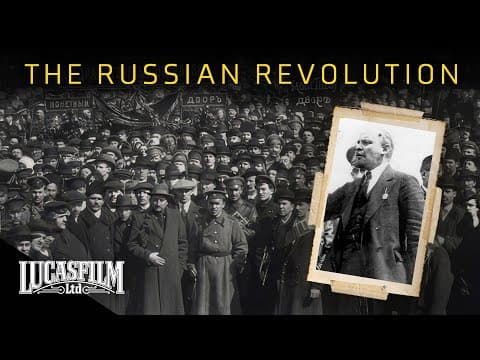
The Russian Revolution of 1917, which promised equality and social justice, ultimately led to authoritarianism and violence, culminating in the rise of Stalin. This blog post explores the revolution's origins, key events, and its profound impact on Russia and the world.
In 1991, the Soviet Union, once one of the most powerful nations on earth, collapsed. Its origins can be traced back to the socialist revolution of 1917, which sent shockwaves around the world. The Russian Revolution not only shaped the 20th century but also influenced the rise of ideologies such as Nazism and Fascism as counter-revolutions against Bolshevism. This blog post delves into the promises of the revolution, the socio-political landscape of Russia at the time, and the eventual outcomes that led to a stark contrast between hope and despair.
As the 20th century began, the Romanov Dynasty had ruled the vast Russian Empire, covering one-sixth of the world’s landmass, with an iron grip for nearly 300 years. The regime had only recently freed millions of peasants from slavery, yet Russia remained the most repressive major state in Europe. The absence of legal rights, censorship, and lack of participation in governance left the majority of the population in dire conditions. While a tiny elite lived in splendor, the vast majority were impoverished peasants, with staggering statistics revealing that in 1900, 50% of the Empire’s children died before age five.
Discontent brewed among the populace, but without mechanisms for change, many saw revolution as the only solution. By 1917, Imperial Russia was embroiled in World War I, suffering catastrophic losses and food shortages. The tipping point came on February 23rd, International Women’s Day, when women factory workers in Petrograd marched for bread, igniting widespread protests against the regime.
The protests quickly escalated, and by February 25th, nearly the entire industrial workforce was on the streets. Tsar Nicholas II ordered his troops to fire on the demonstrators, but many soldiers, seeing the women as their mothers, refused to comply. This moment marked a significant shift in loyalty and control, leading to the abdication of the Tsar on March 2, 1917, and the end of the Romanov dynasty.
The revolution unleashed a multitude of uprisings across the country, with various groups forming their own Soviets, or councils, to represent workers and peasants. The Provisional Government, composed of former upper-class politicians, attempted to maintain control but struggled against the growing power of the Soviets.
The Soviets, formed in response to the revolution, represented a grassroots movement for democracy. They demanded a new political order and the establishment of a Constituent Assembly to draft a new constitution. Political parties began to emerge, including the Socialist Revolutionaries, Mensheviks, and the Bolsheviks, each vying for influence.
Amidst this chaos, Vladimir Lenin, the leader of the Bolshevik Party, returned to Russia from exile. He advocated for transferring power to the Soviets, arguing that true democracy meant empowering the lower classes. His radical ideas shocked many, but the dire conditions of World War I made his message resonate with soldiers and workers alike.
As the Provisional Government faltered, the Bolsheviks gained popularity by promising peace, land, and bread. By September 1917, the Soviets believed it was time to take control of the government. Lenin, who had previously refrained from seizing power, decided to act decisively. On October 24th, the Provisional Government attempted to suppress the Bolsheviks by shutting down their newspapers, which ignited armed confrontations.
The Bolsheviks, supported by soldiers and workers, faced little resistance as they took control of key locations in Petrograd, culminating in the seizure of the Winter Palace. The Bolsheviks declared their authority in the name of the Soviets, but this moment marked the beginning of a shift away from the original revolutionary ideals.
Despite initial support, the Bolsheviks faced challenges in governing. They held the first and last free elections in Russia for over 70 years, where they won in major cities but were outperformed by the Socialist Revolutionaries overall. Rather than relinquish power, Lenin closed the Constituent Assembly when it refused to recognize his government, marking a significant departure from the revolutionary ideals of democracy and representation.
The Bolshevik regime quickly descended into authoritarianism, employing censorship, secret police, and state terror. The civil war that followed between the Bolshevik Red Army and the White Army resulted in staggering brutality and millions of deaths. While Lenin did fulfill some promises, such as land redistribution, the methods employed to maintain power laid the groundwork for the rise of Joseph Stalin, whose reign would be marked by even greater atrocities.
The Russian Revolution began as a hopeful movement for social justice and equality but ultimately devolved into a regime characterized by terror and oppression. The initial dreams of ordinary men and women for a better society were betrayed by the very leaders who rose to power in their name. The legacy of the revolution serves as a poignant reminder of how revolutionary ideals can be corrupted, leading to unforeseen consequences that shape the course of history for generations to come.



















