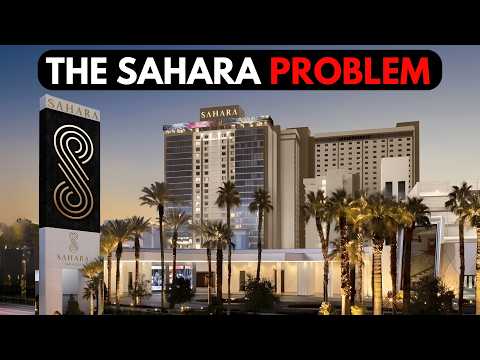
The Sahara Hotel in Las Vegas, an iconic casino with a rich history, underwent a massive $und00 million renovation to revive its former glory. Despite strategic advantages like free parking and a prime location, the hotel struggles with operational failures, poor service, and stiff competition from nearby mega-resorts. Its future hinges on addressing these core issues to avoid repeating past failures.
For those familiar with old-school Las Vegas, the name Sahara resonates deeply. More than just another casino, it was a symbol of classic Vegas glamour. Opening its doors on October 7th, 1952, the Sahara quickly became a hotspot where legendary acts like the Beatles and the Rat Pack left their mark. Over decades, it witnessed the city's highs and lows, standing as a testament to Vegas' evolving identity.
However, legacy alone cannot sustain a business. After years of financial struggles, the Sahara closed in 2011—not for a simple remodel but due to financial collapse. It remained dormant briefly before attempting a comeback as the SLS Las Vegas, which ultimately failed. Now, under new ownership by Alex Marulo, hundreds of millions of dollars have been invested in a massive overhaul, aiming to restore the Sahara's former glory.
Yet, as of 2026, troubling signs have emerged. Employee whispers and visitor complaints suggest history might be repeating itself. The pressing question is whether this extensive renovation represents a genuine revival or merely a temporary fix delaying an inevitable decline.
One of the Sahara's biggest competitive advantages is its offering of completely free parking—a rarity on the Las Vegas Strip where parking and resort fees are widely disliked. This move was designed to attract tourists frustrated by these fees.
A frequent visitor from Los Angeles shared, "I picked the Sahara specifically for the free parking. It saves me almost $30 a day, but would I come back? I'm not sure. The service inside made me feel like I pay for that savings and frustration."
This strategy hinges on attracting a large number of guests who will spend heavily in the casino and restaurants. However, if the economy slows or competition intensifies, the cost of free parking could force the Sahara to cut services elsewhere, potentially harming the guest experience.
The Sahara boasts over 95,000 square feet of event space, positioning conventions as a stable financial pillar. Convention business is generally less volatile than leisure tourism.
However, the convention market remains shaky. A Chicago-based event planner noted, "We looked at the Sahara for our conference. The space is nice, but many of our members are still hesitant about travel with tight budgets. A virtual meeting is still a safer bet."
If convention revenue does not rebound as hoped, the Sahara faces tough choices: absorb losses or cut services, which could trigger a downward spiral.
Historically, the north end of the Strip was a dead zone, isolating the Sahara. But recent developments, including the arrival of Resorts World and the revival of Fontainebleau (referred to as Font and Blow), have transformed the area into a strategic hotspot.
This newfound location advantage is also a threat. A casino market analyst with three decades of experience stated, "The Sahara isn't a fight it can't win on muscle alone. It's a small boat caught between two battleships. If Fontainebleau or Resorts World start a price war, Sahara will be the first casualty."
Thus, the Sahara is squeezed between two giants, risking being drained of its lifeblood.
To build a stable income source, the Sahara invested in an appealing restaurant portfolio offering value for money. Notably, Joseé Andres's Bazaar Meat is praised as one of the best steakhouses in the city.
Despite great food options, service remains a weak link. A former server revealed anonymously, "We were pressured to be fast. There was no time to build a connection. Management only cared about turning tables."
Customers have noticed this too. One diner celebrating a birthday wrote, "The food was great, but our server seemed like he wanted us gone as soon as possible. They dropped the check on the table before we could even order coffee. It ruined a special evening. A five-star restaurant with one-star service is just a one-star experience."
Hundreds of millions were spent redesigning the casino to be brighter and more open, shedding the dark, clubby feel of the SLS era. Hotel rooms were upgraded, and a grand new entryway was built to impress guests from the moment they arrived.
However, private experiences tell a different story. A family from Texas who paid extra for a room in the Blanca Tower found it ridiculously small. The father said, "Every time my wife opened the closet door, I had to press myself into the corner. My kids joked that we were playing real-life Tetris just to get to the bathroom."
A vlogger highlighted a bizarre bathroom design requiring guests to walk through the closet to reach the shower, with the toilet hidden behind a mirror. He commented, "They spent millions on a lobby but turned my bathroom into an escape room puzzle. The luxury is a thin veneer."
This contrast between glamorous public spaces and awkward private rooms signals misplaced priorities.
The Sahara positioned itself as a boutique hotel—compact, intimate, and less overwhelming than mega-resorts. The casino floor is about 60,000 square feet, creating a more personal atmosphere. A new entrance connecting directly to the Monorail station adds convenience.
However, this convenience is marred by understaffing. A visitor from Vancouver, "Sarah," shared, "I came in on a redeye flight tired and just wanted to get to my room, but I had to stand in line for over an hour. There were only two clerks working, and they looked more exhausted than the customers."
The boutique model requires swift service, but understaffing turns this promise into frustration.
After the failed SLS era, billionaire Alex Marulo bet on the Sahara's 70-year legacy to create an emotional connection with older guests, making them feel like they were coming home.
Throughout the hotel, black-and-white photos of legends like Elvis, the Beatles, and Frank Sinatra adorn the hallways, creating a museum-like atmosphere.
Yet, this nostalgia is a double-edged sword. A bartender with over 20 years on the Strip said, "We're not encouraged to chat here. It's just pour the drink, take the money, and move to the next person. The soul of old Vegas isn't in this place."
A couple from Ohio visiting for their anniversary complained about standoffish staff and unresponsive room service. The nostalgic veneer may attract guests, but the soul and service inside are lacking.
Despite the extensive renovation and strategic positioning, the Sahara's biggest challenge lies in day-to-day operations. Long check-in lines, awkward room layouts, and overworked employees are not isolated incidents but symptoms of deeper issues in management, training, and company culture.
A hotel is more than its physical structure; it is a service machine. Currently, the Sahara's machine is sputtering.
The Sahara stands at a critical juncture. It has an iconic brand, a strategic location, and a unique competitive advantage in free parking. However, it faces formidable rivals, a volatile market, and internal weaknesses eroding customer trust.
The renovation has given the Sahara a new heart, but operational failures clog its circulatory system. A fresh coat of paint may attract guests once, but only excellent service will ensure they return.
Alex Marulo's gamble is ongoing, but time is running out. Without swift and effective improvements in service and operations, the Sahara risks not just repeating history but being buried by it.
Have you stayed at the Sahara since the renovation? What was your experience? Share your stories and insights to help paint a fuller picture of this iconic Las Vegas hotel's future.