This article explores the 1895 painting "Mephisto" by Edward von Grützner, which portrays the demon Mephistopheles from the Faust myth not as a monstrous figure but as an elegantly dressed elderly man. The depiction highlights the seductive and rational nature of evil, emphasizing temptation through familiarity rather than fear, and reflects on the enduring influence of the Faustian bargain in Western literature and art.
The painting we are examining is titled Mephisto, created in 1895 by the German artist Edward von Grützner. While Grützner may not be widely known today, his portrayal of Mephistopheles—the demon from the Faust myth—is strikingly unique and thought-provoking.
Mephisto is a shortened form of Mephistopheles, a demon who plays a central role in the Faust legend. This myth gained immense popularity across Europe toward the end of the Middle Ages. Faust is a cultured, brilliant, and ambitious man who, despite his vast knowledge in astronomy, medicine, theology, and philosophy, remains deeply dissatisfied. He yearns for more—more knowledge, power, and experiences beyond the limits of the human condition.
Unable to find fulfillment through ordinary means, Faust summons an infernal spirit, and Mephistopheles appears. Unlike traditional depictions of demons as monstrous beings with horns or wings, Mephistopheles is presented as an elegant, charismatic figure who offers Faust a pact: for 24 years, Faust will enjoy unlimited knowledge, renewed youth, and unrestricted pleasure. In exchange, at the end of this period, his soul will belong to Mephistopheles.
This Faustian bargain has become one of the most influential ideas in Western literature, evolving through various interpretations over centuries. Christopher Marlowe’s 1592 play portrayed Faust as a tragic figure torn between desire and guilt, while Goethe’s 1808 version elevated Faust’s quest to a search for meaning itself, symbolizing the modern man’s pursuit of purpose.
It is important to clarify that Mephistopheles is not Lucifer but rather an intermediary or messenger acting on behalf of others. His power lies not in violence or fear but in seduction and rational persuasion. He understands human desires and offers to fulfill them, presenting a tempting option rather than forcing compliance.
This subtlety is central to the story’s message: it is not merely about selling one’s soul but about what one is willing to sacrifice to obtain their deepest desires.
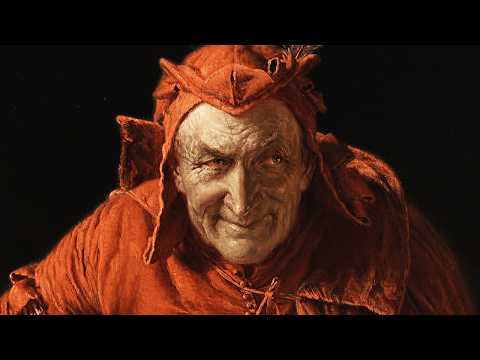
Grützner’s Mephisto stands out because it humanizes the demon. Instead of a grotesque creature, Mephistopheles appears as an elderly man dressed elegantly in a red suit, leaning slightly forward with a complex expression that is difficult to define. He smiles subtly, as if enjoying the moment of temptation he offers.
His attire is notable: a fitted red tunic buttoned to the neck and a matching hat adorned with an exaggerated feather. At the time, feathers in hats were uncommon in everyday wear and were more associated with theatrical costumes or courtly figures. This choice aligns with literary traditions where Mephistopheles often disguises himself or adopts a pleasant human form to appear less threatening.
What makes Grützner’s painting particularly unsettling is how deeply human Mephistopheles appears. There are no horns, no fire, no monstrous features—just a man with a confident posture and a gaze that feels disturbingly familiar. This depiction suggests that evil does not always manifest as something obviously terrifying but often as something reasonable, tempting, and charming.
The demon’s gaze follows something or someone outside the frame, creating an uneasy tension and inviting viewers to wonder about the unseen. This subtle interaction enhances the painting’s power, making it feel as though Mephistopheles could be someone you have encountered in real life.
Grützner was not the first artist to depict Mephistopheles. For example, Friedrich Moritz August Wichmann’s painting shows Faust and Mephistopheles playing chess, symbolizing the struggle for Faust’s soul. Mephistopheles moves the pieces confidently, while Faust appears frustrated, sensing his impending loss. This scene captures the essence of the myth: the demon does not attack but waits for the wrong decision.
Other artists, like Uyan Dequa, have portrayed Mephistopheles as a darker, more grotesque figure with wings, emphasizing his supernatural and terrifying aspects.
In contrast, Grützner’s work brings Mephistopheles down to earth, giving him a body, age, and personality, transforming him into someone real and relatable.
Edward von Grützner’s Mephisto challenges traditional notions of evil by presenting the demon as a disturbingly human figure. This portrayal reminds us that temptation and evil often come not as monstrous threats but as familiar, charming presences that appeal to our desires.
The painting invites reflection on the nature of temptation and the choices we make, echoing the enduring relevance of the Faust myth in exploring human ambition, desire, and the cost of seeking more.
Understanding this depiction helps us recognize that evil’s power lies not in fear but in seduction, and that sometimes the scariest form of evil is the one that looks just like us or someone we know.
Thank you for reading this exploration of one of the most compelling artistic interpretations of evil. Your thoughts and reflections on this portrayal are most welcome.