
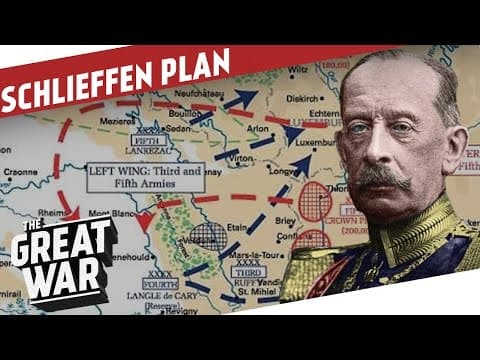
The Schlieffen Plan, designed by Germany to avoid a two-front war in World War I, ultimately failed due to inflexibility, logistical issues, and underestimating enemy capabilities, leading to a protracted conflict.
When World War I began, Germany faced a situation it desperately sought to avoid: a war on two fronts. The initial German strategy, known as the Schlieffen Plan, was crafted to prevent this scenario. In this blog post, we will explore the origins of the Schlieffen Plan, its intended execution, and the reasons behind its failure.
The Schlieffen Plan was developed by Alfred von Schlieffen, who served as the Chief of Staff of the German Imperial Army from 1891 to 1906. The plan began to take shape in 1905, influenced by several factors that emerged since the Franco-Prussian War of 1870-1871.
The original strategy involved deploying 7/8 of German troops to the west to bypass French defenses by marching through Belgium and the Netherlands. The remaining troops would engage the French at the border, drawing them into battles while the main force encircled Paris. After defeating France, the plan called for a transfer of troops to the Eastern Front to confront Russia.
By the time World War I broke out, Schlieffen had been succeeded by Helmut von Moltke the Younger, who made significant alterations to the plan. Notably, he decided to invade only Belgium, leaving the Netherlands untouched as a supply corridor. Additionally, Moltke prioritized the defense of East Prussia, which diverted resources from the original plan.
Despite its ambitious design, the Schlieffen Plan ultimately failed, leading Germany into a protracted two-front war. Several factors contributed to this failure:
The initial troop numbers were inadequate for the ambitious encirclement of Paris. While Germany had a well-equipped army, the reserve and replacement troops were not adequately trained or equipped to implement the plan effectively.
The plan relied heavily on speed and efficient transportation. However, Germany's logistical capabilities were strained. With only 5,000 cars and 1.4 million horses available, the reliance on railways became critical. As the Germans advanced, the Belgians and French destroyed railway tracks, complicating troop movements and supply lines.
Once the Schlieffen Plan was set in motion, it lacked alternatives. A notable incident occurred when Kaiser Wilhelm II received misleading information about French mobilization, prompting him to order a troop deployment to the East. Moltke emphasized that such a deployment could not be improvised, highlighting the rigid nature of the plan.
Effective communication was vital for the plan's success. However, as forces moved closer to the front, communication methods became scarce. The reliance on outdated information led to poor decision-making and delayed responses to changing battlefield conditions.
The original Schlieffen Plan underestimated Russia's military capabilities, dismissing it as a weak opponent due to its recent defeat in the Russo-Japanese War. However, Russia had modernized significantly and mobilized faster than anticipated, forcing Moltke to divert troops from the Western Front to the East.
Internal disagreements within the German command structure further complicated the execution of the plan. For instance, Bavarian forces, under the command of Prince Rupprecht, refused to comply with orders to defend Prussia, leading to further complications in troop movements.
The Schlieffen Plan's failure was a culmination of logistical challenges, inflexible strategies, and underestimating enemy capabilities. Instead of achieving a swift victory, Germany found itself embroiled in a bloody war of attrition on two fronts, a scenario it had sought to avoid. The lessons learned from the Schlieffen Plan continue to resonate in military strategy discussions today.



















