
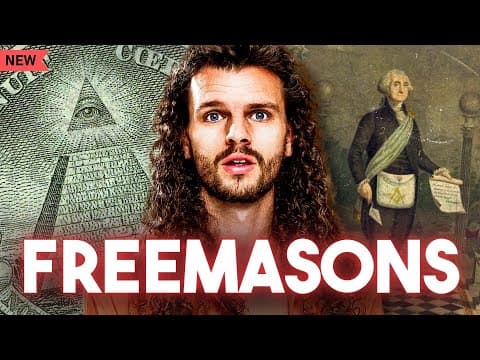
This article explores the secretive history of the Freemasons, tracing their origins from medieval England to their influence in American history, including their role in the American Revolution and the controversies surrounding them such as the disappearance of William Morgan and the P2 scandal in Italy. It also discusses their persecution during World War II and their evolution into modern times.
The Freemasons are one of the most secretive and mysterious groups in human history. Known for their symbols, rituals, and the countless conspiracy theories surrounding them, the Freemasons have fascinated people for centuries. This article delves into the real story behind this ancient brotherhood, exploring their origins, secrets, influential members, dark moments, and their role in history.
The exact beginnings of the Freemasons are shrouded in mystery. Some theories suggest they date back thousands of years to ancient Israel, with King Solomon and the Phoenician architect Hyram Abif as foundational figures. According to Masonic legend, Hyram Abif was murdered by apprentices unworthy of the temple's secrets, a story reenacted in Masonic ceremonies.
However, most modern historians believe Freemasonry originated in medieval England around the 14th and 15th centuries. It evolved from operative stonemason guilds—unions of craftsmen who built castles, churches, and other structures. Over time, these guilds began admitting honorary members, including nobles and wealthy men, transforming into social clubs for the elite.
The earliest written records of Freemasonry, known as the "old charges," date back to around 1430 in Shropshire, England. These documents outlined the rules and history of masonry and emphasized a sacred rule: no member could reveal secrets if it endangered another's life or property.
Freemasonry spread to the American colonies in the early 18th century, with the first lodge established in Philadelphia in the 1730s. Many founding fathers, including George Washington, Benjamin Franklin, and Paul Revere, were Freemasons. The fraternity's ideals of reason, liberty, and fraternity resonated deeply and influenced the American Revolution and founding documents.
However, in 1826, a major scandal shook American Freemasonry. Captain William Morgan, a war hero and former Mason, planned to publish a book exposing Masonic secrets. Before he could do so, he was mysteriously arrested and disappeared without a trace. Many believed the Freemasons were involved in his disappearance, sparking the anti-Masonic panic.
Thousands of members quit the organization, and the number of lodges drastically declined. The scandal led to the formation of the Anti-Masonic Party, the first third party in American politics, opposing Freemasonry's perceived corrupt influence.
In 1775, Prince Hall, a free Black man in Boston, and 14 other free Black men were initiated into a British military lodge. After the Revolutionary War, they petitioned to form their own lodge, receiving a charter in 1784, creating the first Black Masonic lodge in America.
Prince Hall Freemasonry became a vital institution for African Americans, providing a space for leadership, community, and dignity during times of rampant racism and exclusion. Despite this, mainstream American Freemasonry often refused to recognize Prince Hall lodges until the late 20th and early 21st centuries.
The pluralistic and secretive nature of Freemasonry made it a target for totalitarian regimes. When the Nazis rose to power in Germany in 1933, they viewed Freemasons as a threat to their control. The Nazi regime banned Freemasonry, confiscated their property, and sent many Freemasons to concentration camps.
Similarly, in Italy, the fascist regime opposed Freemasonry. A secret Masonic lodge called Propaganda Due (P2), led by Licio Gelli, became involved in anti-communist operations, political scandals, and criminal activities, including false flag terrorist attacks and financial fraud involving the Vatican bank.
The P2 scandal rocked Italy in the 1970s and 1980s, revealing connections between Freemasonry, organized crime, and political corruption. The lodge was eventually disbanded in 1982.
Today, millions of Freemasons exist worldwide, from the United States to Japan and South America. While historically associated with powerful and wealthy men, modern Freemasonry often functions as a social and philanthropic organization.
One well-known branch is the Shriners, famous for their red fez hats and community work, including hospitals for children that provide care regardless of ability to pay.
Freemasonry means different things to different people, but at its core, it remains a fellowship of men seeking self-improvement, community betterment, and brotherhood.
The Freemasons have played diverse roles throughout history—from medieval guilds and revolutionary thinkers to controversial secret societies and philanthropic organizations. Their story is one of complexity, duality, and enduring mystery.
While conspiracy theories abound, the Freemasons' true influence has waxed and waned over time. They have left an undeniable mark on history and continue to fascinate people worldwide.
Understanding the Freemasons offers insight into human nature, society, and the interplay of secrecy, power, and community.
What do you think about the Freemasons? Are they a force for good, a shadowy power, or simply a historic fraternity? Share your thoughts and continue exploring this captivating secret society.



















