
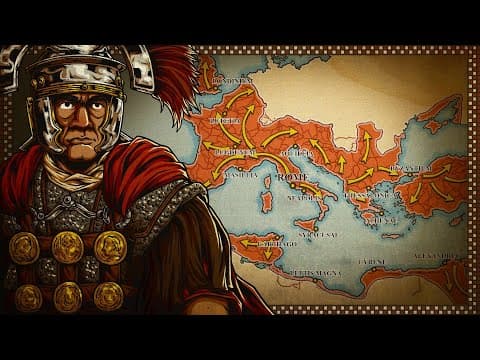
The Roman Empire's remarkable expansion and control were driven by a powerful military, strategic reforms, efficient bureaucracy, and cultural integration, allowing it to thrive for centuries across vast territories.
In 116 CE, under Emperor Trajan, the Roman Empire reached its greatest territorial extent, stretching from the Atlantic Ocean to the Caspian Sea and from the British Frontier to the heart of Mesopotamia. This unprecedented expansion was not only a testament to the might of the Roman military but also to the Empire's ability to maintain control over its vast territories for centuries. This blog post explores the key factors that contributed to the Roman Empire's efficient expansion and governance.
The backbone of Rome's expansion was its powerful military. From its founding in the 8th Century BCE, Rome adapted quickly to new threats, evolving its military strategies from skirmishes with neighboring Italic peoples to full-scale territorial domination. The influence of Greek military equipment and tactics significantly transformed Roman warfare.
By the late era of the Roman Kingdom, reforms under King Servius Tullius mandated military service from Roman citizens, leading to a more organized and professional army. The rise of the Republic in the late 6th Century BCE further professionalized the military, culminating in the establishment of four legions organized under a flexible manipular system. This adaptability was crucial during conflicts such as the Punic Wars against Carthage, where Rome learned the importance of logistics and long-term strategy.
Under General Gaius Marius, military participation was opened to the landless poor, transforming the army into a professional standing force. Soldiers served longer terms and were equipped with standardized gear, often funded by the state. This shift from a part-time militia to a full-time army was essential for sustaining prolonged military campaigns.
The success of the Roman legions was also dependent on the leadership qualities of their commanders and the political infrastructure that supported them. Roman generals were encouraged to be opportunistic and adaptive, seizing advantages on the battlefield. The Senate and other political bodies mobilized resources to support military endeavors, fostering a culture of loyalty and duty among citizens.
The Roman Empire's vastness necessitated an efficient bureaucracy and taxation system. Drawing inspiration from earlier Persian administrative practices, Rome developed a complex tax system that funded the military and maintained infrastructure. Taxes varied by region, with land taxes assessed based on productivity and customs duties levied on goods transported across the Empire.
The grain supply system, known as the anona, exemplified Rome's bureaucratic management, organizing the collection and distribution of grain to feed the city of Rome and its legions. Written records, such as censuses and land registries, allowed the state to effectively track resources and population.
Maintaining control over conquered territories required more than military might; it involved cultural integration. The Romans believed in universal law, striving to create a legal system that applied to all citizens and subjects. This approach helped unify diverse populations under Roman rule.
The gradual extension of Roman citizenship, initially granted partially, allowed conquered peoples to enjoy legal protections and trade rights. Over time, some subjects could achieve full citizenship, which conferred significant privileges. This strategy fostered loyalty to Rome and created invaluable pools of talent across the Empire.
Despite their often dismissive attitude towards foreign cultures, Romans pragmatically respected local customs and traditions. By allowing varying degrees of local autonomy, Rome reduced resistance to its rule. Client states and allied territories created a network of semi-independent regions loyal to Rome, further stabilizing its borders.
The wealth generated from conquests and trade was crucial for Rome's expansion. Roman merchants engaged in trade across the Mediterranean, importing luxury goods and resources that funded military campaigns and public works. Urbanization and the establishment of colonies were vital strategies for securing and romanizing newly conquered territories.
Veterans of the legions were often settled in these colonies, creating loyal populations that facilitated the spread of Roman customs, language, and law. This cultural integration strengthened control over provinces and expanded the recruitment pool for new legions.
The Roman Empire's ability to expand and maintain control over its vast territories was a multifaceted achievement. Through military strength, administrative efficiency, economic integration, and cultural assimilation, Rome established a proven formula for sustaining its power. Even after Trajan's reign, the Empire continued to thrive for centuries, leaving a lasting legacy that influenced modern law, infrastructure, and culture across the globe. The lessons learned from Rome's expansion and governance remain relevant today, showcasing the importance of adaptability, organization, and cultural integration in building and maintaining a successful state.



















