
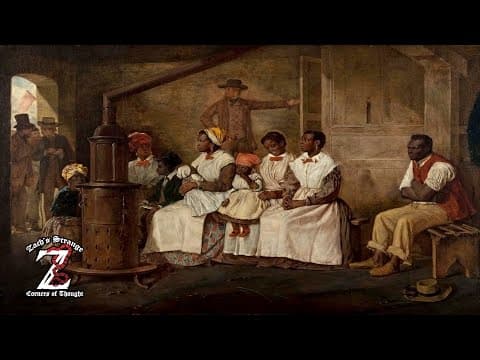
This blog post explores the sexual economy of American slavery, highlighting how enslaved women's reproductive and sexual labor contributed to capitalist wealth, the legal implications of their status, and the lasting impact of these dynamics on contemporary society.
The history of slavery in the United States is often viewed through the lens of economic exploitation and human rights violations. However, a critical aspect that has been less discussed is the sexual economy that developed within the institution of slavery. This blog post delves into the unique sexual economy of American slavery, examining how it exploited the reproductive and sexual labor of enslaved women and contributed to capitalist wealth.
Slavery has existed throughout human history, but the American variant was particularly unique due to its reliance on the sexual exploitation of enslaved women. Between 12.1 and 12.8 million Africans were forcibly taken to the Americas during the transatlantic slave trade, with a significant number not surviving the journey. Despite the low influx of new slaves to North America, by 1825, the United States had the largest enslaved population in the Americas, largely due to the natural reproduction of enslaved individuals.
The reproductive capacity of enslaved women was crucial for the survival of slavery in the United States. Elite members of antebellum society viewed enslaved women's ability to bear children in economic terms, often referring to their reproductive labor as a capital asset. This perspective was not only prevalent among slaveholders but also reflected in legal decisions that prioritized the economic value of enslaved women's childbearing abilities.
The legal system in the United States played a significant role in shaping the sexual economy of slavery. For instance, in 1656, Elizabeth Key Grinstead successfully sued for her freedom based on her mixed-race heritage, highlighting the complexities of racial identity and legal status. However, subsequent laws, such as the one passed in 1662 by Virginia's House of Burgesses, established that a child's status followed that of the mother, effectively reducing enslaved women to the status of livestock.
Under American law, the father of an enslaved child was often deemed irrelevant. This legal framework not only stripped enslaved women of their agency but also contributed to the stereotype of absent Black fathers in contemporary society. Historical cases, such as Hudson v. Wright in 1806, further illustrate how the legal system failed to recognize the rights of enslaved individuals, particularly women.
The sexual economy of slavery extended beyond reproductive labor to include sexual exploitation. Enslaved women's bodies were viewed as commodities, subject to the desires of their enslavers. The legal system often failed to protect enslaved women from sexual violence, as seen in the 1859 case involving an enslaved man named George, whose conviction for raping a child was overturned because the law did not recognize enslaved women as persons.
The constant threat of sexual violence served as a tool for maintaining control over the enslaved population. Angela Davis notes that rape was used as a weapon of domination, aimed at demoralizing both enslaved women and men. This dynamic reinforced the power imbalance between enslavers and the enslaved, perpetuating a cycle of oppression.
The legacy of the sexual economy of slavery continues to influence contemporary society. The legal irrelevance of fathers in the context of slavery has contributed to enduring stereotypes about Black fatherhood. Despite the narrative that Black fathers are absent, research indicates that many are actively involved in their children's lives, challenging the myths perpetuated by historical injustices.
Recent studies, including those from the 23andMe project, reveal that while 60% of enslaved individuals brought to the Americas were men, enslaved women contributed significantly more to the modern gene pool of people of African descent. This finding underscores the profound impact of the sexual economy on the genetic legacy of African Americans today.
The sexual economy of American slavery was a complex system that exploited the reproductive and sexual labor of enslaved women, contributing to the wealth of the slaveholding class. Understanding this aspect of slavery is crucial for comprehending its lasting effects on contemporary society, including the stereotypes and challenges faced by Black families today. The history of slavery is not just a relic of the past; it continues to shape the social and economic landscape of the United States.



















