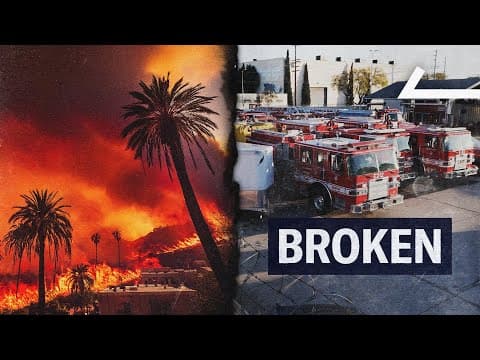
The US is facing a severe fire truck shortage due to private equity firms monopolizing the market, leading to skyrocketing prices and delayed deliveries, ultimately compromising public safety.
As fires raged through Los Angeles earlier this year, firefighting teams found themselves handcuffed—not by a lack of water or poor forest management, but by a more fundamental issue: a severe shortage of operational fire trucks. Approximately 100 fire vehicles in L.A. were out of commission, not due to bureaucratic mismanagement, but because of a cynical manipulation of the market by private equity firms.
Fire departments across America are grappling with a crisis where having functional fire trucks has become a luxury. Fire Chief Gil Carpenter from Salem, Arkansas, shared his experience with a $1 million fire truck that was out of service for ten months. This truck, which should have been a reliable asset, was rendered useless due to a lack of parts and repairs.
"Ten years ago, the part would have arrived in days," Carpenter lamented, highlighting the drastic changes in the supply chain. The cost of fire trucks has also skyrocketed; a truck that cost $350,000 in 2016 now costs nearly $1 million.
The ramifications of this shortage are felt across the board. Local governments are forced into impossible choices, with delivery times for new trucks stretching to 36 to 48 months. This situation is not confined to urban areas; rural communities are also struggling, often relying on outdated trucks that are 50 to 60 years old.
Carpenter explained that even small towns can no longer purchase hand-me-downs from larger cities because those cities cannot procure new trucks. The entire system is interconnected, and the lack of available parts for repairs exacerbates the problem.
The root of this crisis can be traced back to a private equity fund called American Industrial Partners. Basel Musharbash, a lawyer who has investigated this issue, explained that private equity firms saw an opportunity in the fire truck market, which is always in demand due to taxpayer funding.
Historically, the fire truck industry was competitive and regional, but Wall Street's interest led to a consolidation of manufacturers. The REV Group, a conglomerate formed by merging several fire truck and emergency vehicle manufacturers, now controls about 30% of the market. However, the real market power is much greater, as many smaller manufacturers rely on the REV Group for their vehicle bodies.
The consolidation of the fire truck manufacturing industry has led to significant delays and price increases. When fire chiefs struggled to find equipment during the COVID-19 pandemic, the delays were attributed to supply chain issues. However, the situation worsened even after the pandemic, with wait times for new trucks extending beyond what was previously experienced.
REV Group's strategy involved raising prices by limiting competition, which became easier as local governments received COVID assistance funds to upgrade their fire fleets. This created a scenario where communities were competing against each other for limited fire truck supplies, allowing REV Group to increase prices significantly.
The consequences of this profit-driven approach are dire. Fire Chief Carpenter expressed concern that public safety is being sacrificed for profits. The situation in Los Angeles, where the fire department had around 185 fire trucks waiting for repairs while fires raged nearby, illustrates the critical nature of this issue.
The inability to deliver parts and the monopolistic practices of the REV Group have left many fire departments in precarious situations. In one instance, a fire truck sat unused for over a year, representing a significant risk to public safety.
The alarming situation in the fire truck industry should serve as a wake-up call for local governments. The monopolistic practices of the REV Group are not isolated; similar issues are occurring in various industries that local governments rely on.
Fortunately, the solution lies within existing antitrust laws. It is illegal for companies to engage in such monopolistic behavior, and there are mechanisms in place to break up the REV Group's stranglehold on the fire truck manufacturing industry. The federal government has intervened in similar situations before, and it could do so again to protect public safety.
In conclusion, the fire truck shortage in the U.S. is a complex issue rooted in market manipulation by private equity firms. As communities struggle to maintain their fire services, it is imperative that action is taken to restore competition and ensure that public safety is prioritized over profits.