
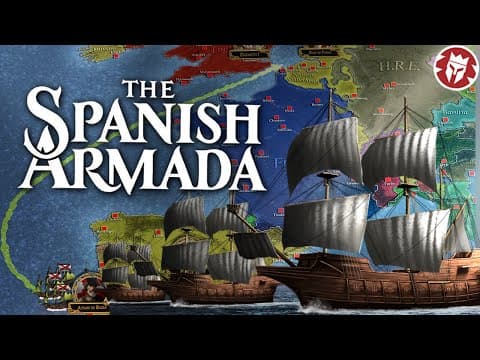
The Spanish Armada's attempted invasion of England in 1588 marked a pivotal moment in naval history, showcasing England's strategic prowess and resilience against a larger force. This blog post explores the events leading up to the Armada's launch, the battles fought, and the ultimate failure of the Spanish fleet, which reshaped the balance of power in Europe.
Between 1554 and 1558, Spain and England were united against a common enemy, France, following the marriage of Philip II of Spain and Mary Tudor. However, the death of Mary on November 17, 1558, and the ascension of her Protestant half-sister Elizabeth to the throne marked the beginning of rising tensions between the two nations. This tension culminated in 1588 when nearly 200 ships of the Spanish Armada set sail to invade England, igniting one of naval history's most significant conflicts.
Throughout the 1560s, the relationship between England and Spain deteriorated. Religious differences, stemming from Henry VIII's break with the Catholic Church, fueled animosity. Philip II covertly supported plots to restore Catholicism in England and ordered the capture of English trading ships in the Americas. In retaliation, Elizabeth I encouraged privateers like Francis Drake to attack Spanish shipping routes.
The situation escalated in 1572 when Protestant Dutch rebels, supported by England, intensified their uprising against Spanish rule in Flanders. By 1580, tensions reached a boiling point when Philip demanded punishment for Drake's actions, only for Elizabeth to knight him instead. The conflict further intensified with Spanish attempts to support Irish uprisings against English rule.
The naval confrontation began in earnest on July 26, 1582, during the Battle of Vila Franca do Campo, part of the War of the Portuguese Succession. Following a decisive Spanish victory, Philip II began to contemplate a full-scale invasion of England. In 1585, after a series of victories by the Duke of Parma against Dutch rebels, Elizabeth committed more support to the Dutch cause, further aggravating tensions.
The assassination of Mary, Queen of Scots, in 1587 prompted Philip to accelerate his invasion plans. Admiral Don Alvaro de Bazan, Marquis of Santa Cruz, began assembling the Great Armada in Lisbon, intending to join forces with Parma and invade England.
On May 10, 1588, the Great Armada finally set sail from Lisbon, but adverse winds delayed its departure. After two weeks, favorable winds allowed the fleet to move out, but they faced further challenges, including spoiled supplies and illness among the troops. The death of Admiral Santa Cruz in February 1588 led to the appointment of Don Alonso Perez de Guzman, Duke of Medina Sidonia, who was inexperienced at sea but accepted the command.
Medina Sidonia's mission was to avoid engagement with the English fleet and to rendezvous with Parma's forces. However, communication issues between the two commanders created confusion about their meeting point.
On July 30, the Armada sighted the Lizard Peninsula in Cornwall, prompting the English to prepare for battle. The first engagement occurred on July 31 off Eddystone Rock, where the English fleet, led by Lord Charles Howard, utilized their smaller, more maneuverable ships to their advantage. The English ships were equipped with superior artillery, allowing them to fire more frequently than the larger Spanish vessels.
Despite the initial skirmishes, the Spanish Armada continued its eastward journey, suffering setbacks such as a gunpowder explosion on the San Salvador and a collision that left the Rosario crippled. As the English fleet pursued, the Spanish faced further challenges, including a lack of supplies and the need to regroup.
On August 6, the Armada reached the Straits of Dover, where they encountered a strong English force. The English employed a tactic involving hell-burners—ships set ablaze and sent into the enemy fleet to disrupt their formation. This tactic caused chaos among the Spanish ships, forcing them to scatter.
The subsequent Battle of Gravelines on August 8 marked a turning point. The English fleet, now bolstered by reinforcements, engaged the Spanish in fierce combat. Despite the Spanish's superior numbers in infantry, the English ships' agility and firepower allowed them to inflict significant damage.
As the battle raged, both sides faced dwindling supplies and worsening weather conditions. By the end of the engagement, the Armada had lost several ships and suffered heavy casualties, while the English losses were minimal.
Following the Battle of Gravelines, Medina Sidonia realized that continuing the invasion was futile. With the English fleet in pursuit, the Spanish Armada attempted to circumnavigate the British Isles to return home. However, they faced severe storms and supply shortages, leading to further losses.
By mid-September, many Spanish ships were wrecked along the Irish coast, and by the time Medina Sidonia returned to Corunna on September 21, only a fraction of the original fleet remained. A total of 44 vessels were lost, and approximately 11,000 men died, primarily from disease.
In contrast, the English fleet emerged relatively unscathed, having lost no ships in battle and only about 100 men. However, they too suffered from disease, with around 3,000 casualties.
The failed invasion of the Spanish Armada in 1588 marked a significant shift in naval power and the balance of influence in Europe. England's successful defense not only preserved its sovereignty but also established it as a formidable naval power. The events of this conflict would resonate for years to come, leading to further confrontations, including the English Counter Armada in 1589, which will be explored in future discussions.



















