
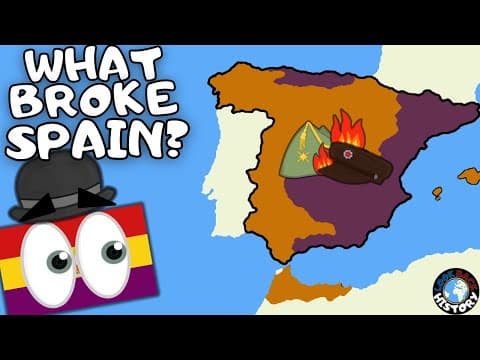
The Spanish Civil War, ignited in July 1936 by a failed coup attempt, stemmed from deep political divisions, economic struggles, and social unrest in Spain. The conflict was fueled by the disillusionment of various factions with the republican government, leading to a violent struggle between the Nationalists and Republicans, ultimately reshaping Spain's future.
In July 1936, a secret cabal of Spanish generals and politicians attempted to topple Spain’s government and install a military junta. Although they did not succeed, this bid for power plunged Spanish society into all-out civil war. By this time, vitriol and violence had already become commonplace in Spain, and the extremes of the political left and right were no longer interested in competing for votes.
Spain, by 1936, was in a state of disarray. Once a dominant global power, it had been reduced to a middling nation, relatively poor and agricultural compared to its European peers. The loss of most of the Spanish Empire in the previous century and a humiliating defeat in North Africa during the 1920s led to a military dictatorship under General Miguel Primo de Rivera, which lasted until 1930. This dictatorship was unpopular and collapsed amidst the Great Depression, leading to the establishment of the Second Spanish Republic.
The republican constitution introduced in 1931 provided Spain with its most democratic regime to date, featuring provisions for freedom of speech, association, and universal suffrage, including women’s rights. However, the republic was fraught with instability, as it struggled to satisfy various factions, including die-hard monarchists and communist revolutionaries.
The republican government was structured similarly to neighboring France and Weimar Germany, with a parliament called el Cortes and a president as head of state. However, the system quickly became unstable. Moderate republicans felt betrayed by constitutional measures that attacked the Catholic Church and allowed the state to seize and redistribute private property. The political landscape was splintered, with no solid democratic majority emerging.
The Spanish left was diverse, ranging from middle-class liberals to Marxists and anarchists. Manuel Azaña emerged as a prominent figure on the left, while the Spanish Socialists (PSOE) and the Communist Party, aligned with Moscow, began to gain influence. On the right, the conservative Catholic party CEDA, led by José María Gil-Robles, grew in power, further polarizing the political climate.
As the republic faced internal strife, workers clashed with capitalists, and laborers confronted landowners. Secular reformers battled traditional Catholics, while regional minorities demanded self-rule. Strikes became common, and armed paramilitary groups emerged on both sides, including the fascistic Falange Española.
In 1933, President Alcalá-Zamora called for fresh elections due to the government's dysfunction. The right gained power, but the CEDA's authoritarian tendencies alienated many. A general strike led to an armed uprising in Asturias, which the government suppressed violently. The political landscape continued to shift, with the left narrowly regaining power in the February 1936 elections through the Popular Front coalition.
As tensions reached a boiling point, General Franco urged the government to use force against the leftists, but they did not act. The CEDA, despite winning the most seats, faced internal dissent as its leader called for non-violent solutions. The removal of Alcalá-Zamora in April 1936 marked a turning point, leading many on the right to abandon republicanism.
The assassination of monarchist politician José Calvo Sotelo by a police officer on July 13, 1936, provided the conspirators with the justification they needed to launch their coup. They painted the government as inept and a puppet of Marxists, positioning themselves as saviors of Spain against a perceived red terror.
The Spanish Civil War was not merely a conflict between two factions but a culmination of years of political disillusionment, economic hardship, and social unrest. Both the Nationalists and Republicans viewed themselves as defenders of their respective ideologies, leading to a brutal and devastating civil war that scarred the nation. Ultimately, Spain survived the conflict, but the scars of extremism and division would linger for generations to come.



















