
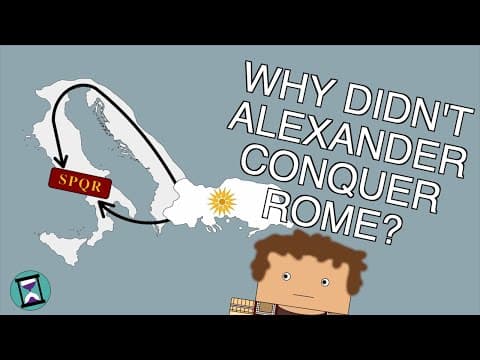
Alexander the Great focused on conquering Persia rather than Rome due to strategic promises, limited knowledge of Rome, and the political landscape of his time. His conquests were driven by the need to unify Greece and secure his empire, ultimately leading him to the East instead of the West.
Alexander the Great is renowned for his military conquests and the cities he named after himself. However, a common question arises: why did he choose to go east instead of west, particularly in not attempting to conquer Rome? To understand this, we must delve into the historical context of Greece in the 4th Century BC.
During this period, Greece was fragmented into a collection of city-states, petty kingdoms, and shifting alliances. At the forefront was the kingdom of Macedon, ruled by Philip II. Philip expanded his kingdom southward, which alarmed Athens. In response, the Athenians formed an alliance to counter Philip's growing power. This led to a series of conflicts, ultimately resulting in Macedonia's victory and the subjugation of most of Greece, with the notable exception of Sparta, which remained obstinate.
Philip II aimed to avenge Persia's previous incursions into Greece. He began preparations for this campaign, but his plans were cut short when he was assassinated. His son, Alexander III, succeeded him and inherited his father's ambitions of expansion. However, turning westward to Rome was not a viable option for several reasons.
One of the primary reasons Alexander did not consider Rome was his father's commitment to attack Persia. This promise served as a unifying force among the Greek city-states. To maintain their support and loyalty, Alexander needed to honor this commitment.
At the time of Alexander's reign, Rome was not yet a significant power. It controlled only a small territory, and neither it nor its neighboring regions appeared to warrant an expedition. Alexander likely had little to no knowledge of Rome, as the Greeks had minimal contact with the city-state. It wasn't until about fifty years after Alexander's death that Rome began its conquests of Greek cities in southern Italy, which would later draw the attention of future leaders.
In 334 BC, Alexander set out to fulfill his father's promise by attacking Persia. His military campaigns were remarkably successful. He defeated the Persian king Darius and expanded his territory significantly, earning the title of Alexander the Great. Following his victories, he moved south into Egypt, where he conquered the region and founded the city of Alexandria, proclaiming himself Pharaoh.
After defeating Darius again and capturing the Persian capital, Darius fled but was soon murdered by his own men. This event allowed Alexander to claim the title of King of Persia, further solidifying his power and influence in the region.
Despite his victories, Alexander could not return to Macedon immediately. He faced the challenge of pacifying the vast territories he had conquered. One of Darius's generals had declared himself king, and Alexander could not tolerate this rival. Over the next six years, he focused on quelling revolts across Persia, ensuring that his realm was secure before considering further expansion.
Once Alexander had stabilized his empire, he turned his attention westward to Babylon. However, at this point, he had other ambitions that diverted his focus. He became preoccupied with the idea of conquering the afterlife, which rendered any plans to move westward towards Rome impossible. Rome remained safe in its cradle, untouched by Alexander's ambitions.
In summary, Alexander the Great's decision not to conquer Rome was influenced by a combination of strategic promises, limited knowledge of the emerging power of Rome, and the political realities of his time. His focus on Persia and the subsequent challenges of governance shaped his legacy as one of history's greatest conquerors, but ultimately, his gaze remained fixed eastward rather than westward.
This exploration of Alexander's choices highlights the complexities of leadership and the impact of historical context on decision-making.
Special thanks to my patrons for their support in creating this content.



















