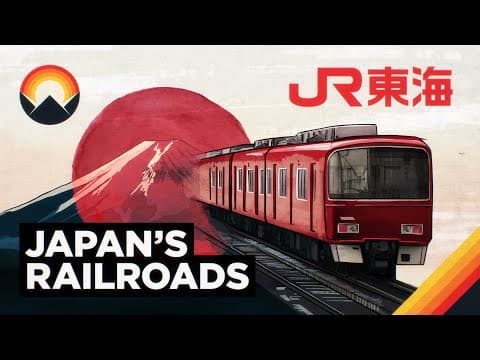
Japan's rail system, particularly the Shinkansen, exemplifies efficiency and reliability, achieving high ridership and profitability through strategic privatization, regional specialization, and innovative real estate development.
When conjuring up an image of Japan’s ultra-successful passenger rail system, one likely thinks of the Shinkansen. This association is well-founded, as the Shinkansen was the world's very first high-speed rail line, reducing the travel time between Japan’s two largest cities from six hours to just three. Since its opening in 1964, the Shinkansen has only gotten faster, adding more services to meet demand. In 2023, it ran an average of 372 trains a day, transporting 158 million passengers throughout the year. Over six decades, the total passenger count has exceeded 6.5 billion, all without a single derailment or fatality.
The success of the Shinkansen opened the door for a nationwide rail network that has become a point of national pride and international envy. Annually, Japanese railways rank alongside countries like India and China in total ridership, with many rail companies turning healthy profits while keeping customers satisfied and services frequent. Notably, much of this ridership and profit is generated by trains operating at conventional speeds.
Take Japan’s southernmost major island, Kyushu, for example. Here, important high-speed rail connections exist, such as the San'yō Shinkansen operated by JR West, which connects Kyushu’s largest city with Osaka in just 2 hours and 28 minutes. JR Kyushu, the island’s main rail operator, runs two additional Shinkansen lines that connect most of the island’s major cities in under an hour and 16 minutes.
However, these high-speed services account for only a fraction of the trips made. JR Kyushu operates eight main and 13 regional lines that serve over 500 stops across the island. For students needing to travel to another university campus, the Shinkansen may not be an option, but other trains are. For instance, they could take the Limited Express Sonic, which runs every 20 minutes and reaches Fukuoka in just 22 minutes for about $15, or opt for a Local Train along the Kagoshima line for around $5, taking 40 to 50 minutes.
Regardless of the choice, rail travel is often the most sensible option, as even local trains are faster than navigating traffic and parking. The average delay across JR Kyushu’s network hovers around a minute, and any delays are promptly communicated to passengers. The trains are also typically well-populated, catering to daily commuters and tourists alike.
In 2023, the Shinkansen accounted for only about a third of JR Kyushu's total rail revenue, while conventional rail carried passengers almost four times the distance. Conventional rail moved approximately 300 million passengers compared to the Shinkansen's 12 million. Thus, while high-speed options contribute to the success of Japanese rail, the foundation lies in the reliability and frequency of conventional passenger trains.
The success of Japan's rail system is not solely due to technological advancements; it is also rooted in a culture of rail travel. Japan's rugged, mountainous topography has led to concentrated and dense population centers. The distances between urban areas, while significant by European standards, are manageable by American or Australian standards, facilitating earlier and easier rail connections.
Historically, the expansion of the rail network was tied to Japan's industrialization in the late 19th century. As the country prioritized growth in the early 20th century, it did so with railroads as a backbone. Post-war, Japan's limited natural exports and favorable trucking conditions meant that passenger rail did not have to compete heavily with freight for line access.
Despite its successes, the Japanese National Railways (JNR), established in 1949, faced significant challenges in the 1980s. After the launch of the Shinkansen in 1964, JNR posted its first loss, and as car ownership rose, the rail system's share of total passenger traffic plummeted. By the mid-1980s, JNR was burdened with a debt of 20 trillion yen, prompting calls for reform.
The privatization of JNR in the mid-1980s involved dividing the organization into nine separate entities, with JR West, JR Central, and JR East managing the core network. This division allowed each company to specialize in its region, optimizing operations based on traffic patterns. For instance, JR Central focused on the high-traffic Tokyo to Osaka route, while JR East concentrated on Tokyo's commuter services.
Each company inherited a mix of profitable and unprofitable lines, ensuring that the burdens and benefits were shared. For example, JR West inherited the profitable Kobe line, while also taking on the less profitable Geibi line. Although technically able to close unprofitable lines, gaining approval is a lengthy process, so companies often continue operating low-traffic lines using profits from high-traffic routes.
A significant factor in the success of Japanese railways post-privatization was the adoption of real estate development strategies. Private rail operators had long recognized that better rail access increased property values. Following privatization, JR companies began leveraging their land holdings for real estate development, diversifying their income streams.
For example, JR East owns the Gala Yuzawa Ski Resort, while JR West has developed a range of hotels and retail operations. This diversification has allowed JR companies to generate substantial revenue from real estate, with JR West reporting that about 20% of its revenue now comes from this sector.
While the privatization of Japan's railways is often cited as a success, not all regions have thrived equally. JR Hokkaido, for instance, struggles with declining ridership and relies heavily on government subsidies. Plans to extend the Hokkaido Shinkansen to Sapporo are underway, but delays have pushed the completion date to 2031.
Despite these challenges, the overall structure of Japan's rail system has proven effective. The combination of regional specialization, government oversight, and a competitive marketplace has created a self-sufficient and efficient service. The success of Japanese railways is a testament to the investment made by the government and taxpayers in building a robust network that continues to benefit the economy and society.
In conclusion, the Japanese rail system exemplifies how effective transportation can be achieved through strategic planning, privatization, and innovative business practices. The lessons learned from Japan's railways can serve as a model for other countries looking to improve their transportation systems.