
The Tejas Revolt, leading to the United States' war against Mexico, is rooted in the complex interplay of Anglo-American expansionism, racial ideologies, and the struggle for independence in Texas. This blog post explores the historical context, key figures, and battles that shaped this pivotal moment in American and Mexican history, revealing the biases and narratives that have influenced our understanding of these events.
The Tejas Revolt, which culminated in the United States' war against Mexico, is a significant chapter in the history of North America. This blog post delves into the historical context leading up to the revolt, examining the factors that contributed to Texas's quest for independence and the subsequent conflict with Mexico. By focusing on key events, figures, and ideologies, we aim to provide a comprehensive understanding of this complex period.
In the early 1830s, Mexico was still recovering from its own fight for independence from Spain, which had lasted over a decade. The political and economic instability that followed left the country fragmented and struggling to establish a cohesive national identity. Many residents in the northern territories, including what is now California and Texas, felt disconnected from the central government in Mexico City, which was thousands of miles away.
During this same period, the United States was driven by the ideology of Manifest Destiny, the belief that it was the nation's divine right to expand westward. This belief was intertwined with notions of racial superiority, as many Anglo settlers viewed themselves as the bearers of civilization and democracy, destined to conquer and colonize the lands inhabited by Native Americans and Mexicans.
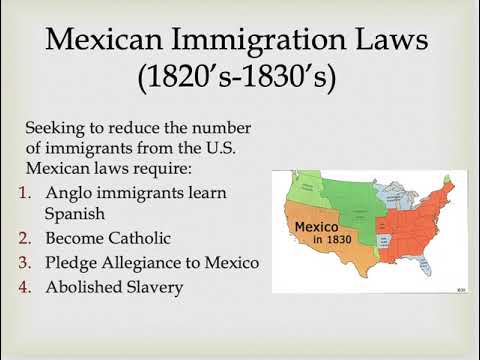
Before the revolt, Anglo settlers began moving into Texas, which was then a province of Mexico. Initially welcomed by the Mexican government, these settlers were granted land under the condition that they learn Spanish, convert to Catholicism, pledge allegiance to Mexico, and abolish slavery. However, the last requirement proved to be particularly contentious, as many settlers came from slaveholding states in the South.
As more Anglo settlers arrived, tensions escalated. The settlers increasingly resisted Mexican laws, particularly those regarding slavery. Figures like Stephen F. Austin, who initially sought to foster good relations, began to express a desire to Americanize Texas, reflecting the growing sentiment of entitlement among Anglo settlers.
The Battle of the Alamo in 1836 has become a symbol of Texan bravery and resistance against tyranny. However, this narrative often overlooks the fact that at the time, Texas was still legally part of Mexico. The portrayal of the Alamo as a fight for freedom against a tyrannical Mexican government simplifies a much more complicated reality. The defenders of the Alamo were, in essence, colonizers attempting to seize control of land that was not theirs.
Following the Alamo, the rallying cry of "Remember the Alamo" fueled further conflict. The subsequent Battle of San Jacinto saw Texan forces, emboldened by the Alamo's legacy, launch a surprise attack on Mexican troops, leading to a decisive victory and the capture of General Santa Anna. This battle solidified Texas's claim to independence, albeit through violent means.
The Treaty of Velasco, signed under duress by Santa Anna, purportedly recognized Texas's independence. However, the legitimacy of this treaty is questionable, as it was signed while Santa Anna was a prisoner of war. The Mexican government never recognized the treaty, viewing Texas as still part of its territory.
In 1845, President James K. Polk, campaigning on a platform of westward expansion, oversaw the annexation of Texas. This act further inflamed tensions between the United States and Mexico, ultimately leading to the Mexican-American War. The annexation was framed as a fulfillment of Manifest Destiny, but it was also a blatant act of aggression against a sovereign nation.
The Tejas Revolt and the subsequent conflict with Mexico reveal the complexities of American expansionism, racial ideologies, and the narratives that have shaped our understanding of history. The events surrounding Texas's independence are often romanticized, but a closer examination reveals a story of colonization, conflict, and the ongoing struggle for identity and belonging. Understanding this history is crucial as it continues to influence contemporary attitudes and relations between the United States and Mexico.



















