
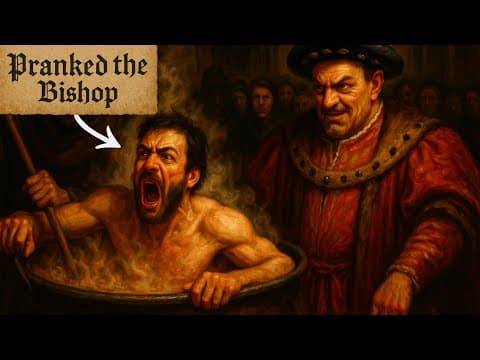
In 1531, Richard Ruse, a cook in Bishop John Fischer's household, faced a horrific fate after a prank led to the poisoning of guests. His execution by boiling alive became a symbol of Tudor justice and the dangers of unchecked power.
In the chilling annals of Tudor England, few stories evoke as much horror as that of Richard Ruse, a cook whose life spiraled into tragedy due to a seemingly harmless prank. This tale unfolds against the backdrop of political tension, religious strife, and the brutal justice system of the time, culminating in a punishment so grotesque that it would leave an indelible mark on history.
The year was 1531, a time when England was on the brink of religious revolution. King Henry VIII sought to annul his marriage to Catherine of Aragon, a move opposed by Bishop John Fischer of Rochester, who championed the queen's cause. This defiance placed Fischer in a precarious position, surrounded by enemies and threats, as the political landscape grew increasingly hostile.
In Fischer's household at Lambeth, paranoia reigned. The fear of poisoning loomed large, as noble households employed tasters to ensure their meals were safe. The kitchen staff operated under constant scrutiny, aware that one mistake could lead to accusations of attempted murder. Among them was Richard Ruse, a cook who would soon find himself at the center of a tragic incident.
On a cold February morning, Ruse prepared a simple porridge intended for the bishop's guests and the poor seeking charity. As he stirred the pot, he reached for what he believed was a harmless powder, intending to add a laxative for a bit of crude humor. However, the powder was deadly poison, and the consequences of his actions would be catastrophic.
As the porridge was served, chaos erupted. Guests at the bishop's table and the poor outside began to fall ill, suffering violent stomach cramps and uncontrollable vomiting. Seventeen people were gravely affected, and two, including a guest named Bennett Kirwan, would die from the poison. Bishop Fischer, by chance, had abstained from the meal, witnessing the horror unfold before him.
With two dead and many more ill, suspicion quickly fell on Richard Ruse. His reaction to the chaos was telling; he seemed to realize the gravity of his mistake. As authorities arrived, Ruse claimed it was a prank gone wrong, insisting he had not acted alone but had been given the powder by a mysterious stranger. This claim, however, lacked corroboration, and investigators found no evidence to support his story.
Ruse was subjected to intense interrogation, where he maintained his innocence, asserting that he had no intention of causing harm. Yet, the authorities were skeptical. In Tudor England, the fear of poison was palpable, and the king's paranoia about threats to his reign only intensified the urgency for justice.
News of the poisoning reached King Henry VIII, who viewed it as a personal affront. His reaction was explosive; he saw an opportunity to demonstrate his power and to instill fear in potential enemies. Henry demanded swift and severe justice, leading to an unprecedented move by Parliament.
In a shocking session, Parliament passed a law retroactively declaring poisoning equivalent to high treason. This law was not only aimed at Ruse but also set a terrifying precedent, allowing for the punishment of actions that had occurred before the law was enacted. The implications were chilling, as it stripped away fundamental legal protections.
Richard Ruse was sentenced to be boiled alive, a punishment that reflected the horror of his crime. The reasoning was twisted: since he had used cooking to kill, he would die by cooking. This method of execution was unprecedented in English law and was designed to serve as a spectacle of justice.
On April 5, 1531, the day of Ruse's execution, Smithfield was transformed into a theater of death. Thousands gathered to witness the gruesome spectacle. Ruse, broken and terrified, was brought forth to face the boiling cauldron. As he was lowered into the scalding water, his screams echoed through the crowd, a haunting reminder of the brutality of Tudor justice.
Richard Ruse's execution left a lasting impact on English society. It served as a grim warning about the dangers of unchecked power and the potential for the law to be manipulated for political ends. The act for poisoning remained on the books until it was repealed in 1547, a testament to its inhumanity.
The story of Richard Ruse is not just a tale of a foolish prank gone wrong; it is a chilling reminder of the lengths to which power can go to instill fear and maintain control. In a world where justice can be twisted to serve the whims of the powerful, the legacy of Ruse's fate continues to resonate, urging us to reflect on the nature of justice and the importance of safeguarding against tyranny.



















