
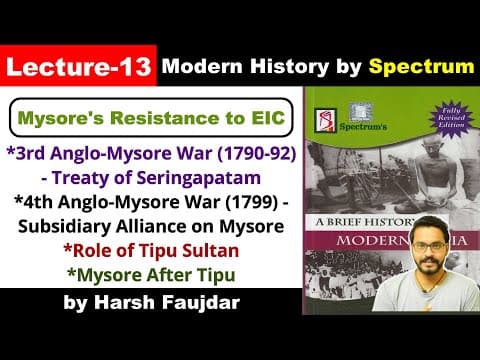
This blog post explores the Third and Fourth Anglo-Mysore Wars, detailing the events leading to the conflicts, the key players involved, and the outcomes, particularly focusing on Tipu Sultan's role and the implications of the treaties that followed.
The Anglo-Mysore Wars were a series of conflicts between the British East India Company and the Kingdom of Mysore in the late 18th century. This post will delve into the Third and Fourth Anglo-Mysore Wars, highlighting the significant events, key figures, and the eventual outcomes of these historical confrontations.
The Anglo-Mysore Wars consisted of four major conflicts:
The Third Anglo-Mysore War began in 1790 and ended in 1792 with the Treaty of Srirangapatnam. The war was primarily instigated by conflicts between Tipu Sultan of Mysore and the Raja of Travancore over territorial disputes, particularly concerning two ports, Jalakotla and Kenor, which were acquired by the Raja from the Dutch. Tipu Sultan viewed this acquisition as a challenge to his authority, leading to his attack on Travancore in April 1790.
The war concluded with the Treaty of Srirangapatnam, which had significant repercussions:
The Fourth Anglo-Mysore War erupted in 1799, following a period of relative peace during which Tipu Sultan consolidated his power after the Treaty of Srirangapatnam. However, tensions escalated due to suspicions of Tipu's alliances with the French and other regional powers.
The Third and Fourth Anglo-Mysore Wars were pivotal in shaping the history of India, marking the decline of the Kingdom of Mysore and the expansion of British colonial power. Tipu Sultan's resistance and his efforts to consolidate power, including his alliances and military strategies, remain significant in the narrative of India's struggle against colonialism. His legacy as the "Tiger of Mysore" continues to inspire discussions about resistance and sovereignty in the face of imperialism.



















