
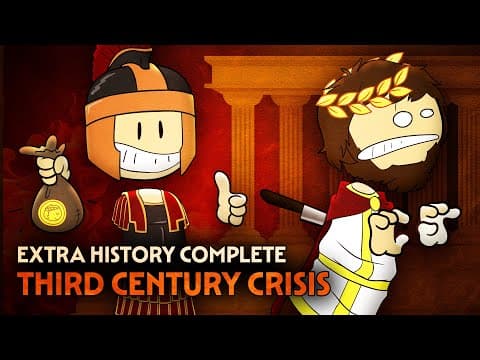
The Third Century Crisis was a tumultuous period in Roman history marked by political instability, economic turmoil, and external invasions. This blog post explores the causes of the crisis, the rise of emperors Aurelian and Diocletian, and their efforts to restore the empire, ultimately leading to significant reforms that shaped the future of Rome.
August 24th, 410 C.E. marks a significant moment in history: for the first time in 800 years, barbarians invaded Rome. This event was not merely a military defeat; it was a personal vendetta. Many of the Visigoths had once served as Roman soldiers, but after the emperor questioned their loyalty, they faced brutal retribution. Their families were murdered, churches were burned, and the ashes of emperors were scattered. This invasion symbolized the decline of the Western Roman Empire, a fate that had been looming for centuries.
The seeds of the Third Century Crisis were sown over a century earlier during a time of division and chaos. The Roman Empire was torn apart by civil wars, and its economy was in free fall. However, two remarkable emperors, Aurelian and Diocletian, would later emerge to preserve the empire against overwhelming odds.
The Third Century Crisis was not a single event but a series of overlapping crises that magnified each other. The primary issue was that the Roman Empire had grown too large to manage effectively. Even the so-called good emperors had expanded the empire to encompass the entire Mediterranean and beyond, stretching resources thin. The military budget consumed half of the empire's annual budget, yet there were not enough troops to secure the vast territories. This neglect led to vulnerabilities that external forces, such as Sassanid Persia and Germanic tribes, were quick to exploit.
The crisis began in earnest with Emperor Severus Alexander in 235 C.E. After a series of military defeats and internal dissent, he was assassinated by his own troops, leading to a chaotic succession of emperors. In just 50 years, 26 emperors would claim the throne, many of them meeting violent ends. This period, often referred to as the Year of Six Emperors, was characterized by instability and rampant military coups.
The economic situation worsened as emperors debased the currency to pay their troops, leading to inflation and a breakdown of trust in the monetary system. The population hoarded coins of higher value, exacerbating the economic crisis. Additionally, a devastating plague further reduced the population and made military recruitment increasingly difficult.
By 268 C.E., the empire had fragmented into three separate entities: the Roman Empire in Italy, the Gallic Empire in Gaul and Britain, and the Palmyrene Empire in the East under Queen Zenobia.
Amidst this chaos, Aurelian emerged as a pivotal figure. Born into humble beginnings, he rose through the military ranks and was declared emperor in 270 C.E. His mission was clear: reunite the fractured empire. Aurelian's military prowess was evident as he successfully defended Rome against invasions and quelled revolts.
One of his first acts was to construct a new defensive wall around Rome, a necessary measure given the empire's precarious state. He also tackled the economic crisis by reforming the currency and addressing corruption within the mint. Aurelian's military campaigns against the Goths and Zenobia's Palmyrene Empire were marked by strategic brilliance, ultimately leading to the reunification of the empire.
His triumphs earned him titles such as "Restitutor Orientis" (Restorer of the East) and "Restitutor Orbis" (Restorer of the World). However, Aurelian's reign was tragically cut short when he was assassinated by his own officers in 275 C.E., just five years into his rule.
Following Aurelian's death, the empire continued to face turmoil until Diocletian ascended to power in 284 C.E. Like Aurelian, Diocletian recognized the need for profound reform. He established the Tetrarchy, a system of rule by four, to better manage the vast empire. Diocletian appointed Maximian as his co-emperor, each overseeing different regions of the empire.
Diocletian's reforms focused on three main areas: securing the empire's borders, stabilizing the economy, and addressing the succession crisis. He expanded the military, reorganized provincial governance, and instituted a new tax system that assessed land value and production.
Despite his efforts, Diocletian's economic policies struggled against the realities of supply and demand. His attempts to control inflation through price edicts largely failed, and the empire's economy remained shaky. However, his administrative reforms laid the groundwork for a more structured and bureaucratic governance model that would endure for centuries.
Diocletian's reign also marked a significant shift in religious policy. Initially known for religious tolerance, he turned against Christianity, viewing it as a threat to the traditional Roman order. The Great Persecution began in 303 C.E., targeting Christians and leading to widespread violence against them. This persecution, however, was not uniformly enforced across the empire, revealing the fractures within the Tetrarchy.
Diocletian's retirement in 305 C.E. did not bring stability. The Tetrarchy quickly unraveled, leading to further civil wars. Despite the challenges, Diocletian's reforms had a lasting impact on the Roman Empire, influencing its governance for centuries to come.
The Third Century Crisis serves as a reminder of the complexities of power, governance, and societal change. While the Western Roman Empire would eventually fall, the foundations laid by Aurelian and Diocletian would shape the future of Rome and its legacy in history.



















