
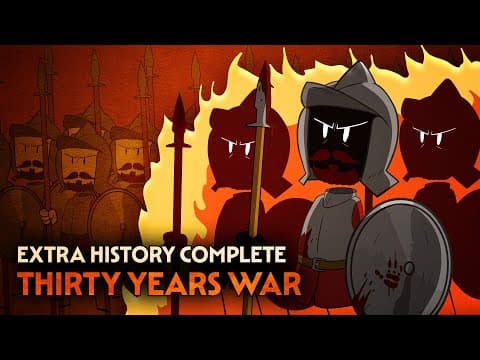
The Thirty Years War (1618-1648) was one of the most devastating conflicts in European history, resulting in the deaths of up to 8 million people. This blog post explores the war's origins, key events, and the humanitarian crises it caused, including military violence, famine, and disease, ultimately leading to the Treaty of Westphalia.
The Thirty Years War, fought from 1618 to 1648, stands as one of the most destructive periods in European history. This conflict, which began as a political and religious dispute within the Holy Roman Empire, escalated into a humanitarian crisis that resulted in the deaths of up to 8 million people. This blog post delves into the origins of the war, its key events, and the catastrophic humanitarian consequences that ensued.
The war's roots can be traced back to the Protestant Reformation, initiated by Martin Luther in 1517. This movement ignited decades of religious conflict across Europe, particularly within the Holy Roman Empire, which became a patchwork of Catholic and Protestant territories. The Peace of Augsburg in 1555 attempted to quell tensions by allowing princes to determine the religion of their realms. However, Calvinists were excluded from this agreement, leaving them vulnerable.
In 1618, the situation in Bohemia deteriorated when Holy Roman Emperor Matthias appointed Ferdinand II, a staunch Catholic, as his successor. Fearing for their religious freedoms, Protestant nobles in Bohemia revolted. The conflict escalated dramatically when two Catholic governors were thrown out of a window at Prague Castle, marking the beginning of the Thirty Years War.
The war quickly spread beyond Bohemia, drawing in various European powers. The Catholic League, led by Ferdinand II, faced off against the Protestant Union, which included Frederick V of the Palatinate. The Battle of White Mountain in 1620 resulted in a decisive Catholic victory, leading to the Habsburgs' control over Bohemia for the next three centuries.
As the war progressed, the conflict transformed from a localized rebellion into a broader European war. The involvement of foreign powers, including Spain, Denmark, and Sweden, further complicated the situation. The war became characterized by brutal military campaigns, with civilian casualties outnumbering military deaths by a staggering ratio of 7 to 1. The siege of Magdeburg in 1631 exemplified the horrors of war, with 20,000 civilians perishing in a single incident.
The war's devastation was not limited to military engagements. Famine became rampant as armies pillaged the land, leading to widespread starvation. The economic conditions in Central Europe deteriorated, exacerbated by the Little Ice Age, which caused poor harvests. The Kipper and Wipper years saw rampant debasement of currency, leading to hyperinflation and skyrocketing food prices. Urban populations, particularly in cities like Bohemia, suffered immensely as they were cut off from food supplies.
The movement of armies and the unsanitary conditions of military life facilitated the spread of disease. Epidemics of typhus and bubonic plague swept through the war-torn regions, killing more people than the battles themselves. By the end of the conflict, it was estimated that 64% of deaths were due to disease, highlighting the war's catastrophic impact on public health.
After three decades of conflict, the war reached a stalemate, prompting negotiations for peace. The Treaty of Westphalia, signed in 1648, aimed to restore stability to Europe. It reaffirmed the principle of "cuius regio, eius religio" (whose realm, his religion), allowing rulers to determine the religion of their territories while also granting limited rights to minority religions.
The treaty marked a significant shift in European politics, establishing the concept of state sovereignty and laying the groundwork for modern international relations. However, it also left unresolved tensions that would continue to affect Europe for centuries.
The Thirty Years War was not merely a series of battles; it was a humanitarian disaster that reshaped Europe. The staggering loss of life, the suffering caused by famine and disease, and the political ramifications of the conflict serve as a stark reminder of the consequences of war. As we reflect on this dark chapter in history, it is crucial to understand the complexities that led to such widespread devastation and the lessons that can be learned from it.



















