
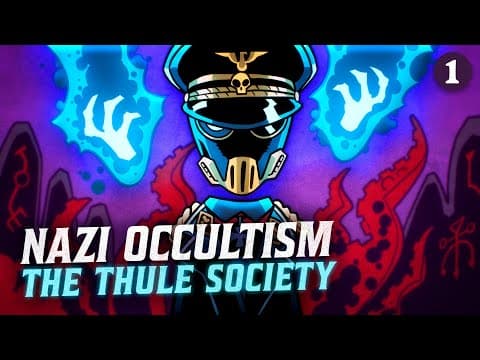
The Thule Society played a significant role in shaping Nazi ideology through its blend of occult beliefs, pseudoscience, and nationalism. This blog post explores the origins of the society, its influence on Nazi thought, and the broader context of occultism in early 20th-century Germany.
The fascination with the occult and mystical beliefs has often been associated with the Nazi regime, leading many to wonder about the extent of this obsession. While popular culture has portrayed these interests through films and literature, the reality is more complex and deeply rooted in the socio-political landscape of early 20th-century Germany. This blog post delves into the Thule Society, its origins, and its significant influence on Nazi ideology.
In the late 19th century, Germany was undergoing significant social and cultural changes. Traditional religious institutions were losing their grip as capitalism and technological advancements reshaped society. Despite this decline, there was a growing yearning for spiritual fulfillment, leading many to explore esoteric religions, spiritualism, and paganism. This quest for meaning was fueled by technological innovations that hinted at a future where the impossible could become possible.
As discoveries in geology and archaeology revealed the Earth's vast history, the idea of ancient civilizations like Atlantis became increasingly appealing. This environment of curiosity and disillusionment set the stage for the emergence of various fringe beliefs, including those that would later influence Nazi ideology.
The Thule Society, founded in the aftermath of World War I, was one of several secret societies that emerged during this period. Named after a mythical northern land mentioned in ancient Greek texts, the society attracted members who were interested in racial nationalism and right-wing politics. Membership required genealogical proof of no Jewish ancestry, reflecting the society's exclusionary beliefs.
Rudolf von Sebottendorff, the society's founder, was an occultist and astrologer who borrowed the swastika symbol from Eastern religions. The Thule Society was not merely a group of eccentric individuals; it was actively involved in the political landscape of post-war Germany. They plotted to kidnap leaders of the newly established socialist republic in Munich and infiltrated military ranks, showcasing their commitment to right-wing extremism.
The Thule Society's beliefs were steeped in pseudoscience and conspiracy theories. They propagated the idea of a "world ice theory," which suggested that cosmic collisions shaped Earth's history and that ancient Aryans had arrived on Earth via comets. This narrative provided a fantastical explanation for the perceived decline of the Germanic race, claiming that their golden age had been disrupted by cataclysmic events.
These ideas resonated with the broader cultural movements in Germany, where folklore and mythology were being reinterpreted to create a national identity. Writers and intellectuals drew upon tales of mythic heroes and supernatural beings, embedding anti-Semitic sentiments within these narratives. The fusion of Christianity with pagan traditions further solidified these beliefs in German culture.
Despite its initial elitism, the Thule Society's influence extended into the political realm. Disillusioned World War I veterans, seeking a sense of belonging and purpose, found a home in the German Workers' Party (DAP), which was founded by former Thule members. This party, characterized by its extreme nationalism and anti-Semitism, would eventually evolve into the Nazi Party.
Adolf Hitler, a decorated war veteran, became involved with the DAP and recognized its potential for greater influence. His leadership transformed the party into a formidable political force, ultimately leading to the establishment of the Third Reich.
The story of the Thule Society and its role in Nazi ideology serves as a cautionary tale about the power of fringe beliefs and the potential for harm they can cause. While it is easy to dismiss the absurdities of Nazi occultism as mere nonsense, it is crucial to recognize how these beliefs contributed to a dangerous political ideology that resulted in immense suffering.
As we navigate a world increasingly filled with disinformation and fringe beliefs, understanding the historical context of such ideologies is essential. The Thule Society's legacy reminds us that even the most outlandish ideas can have profound and devastating consequences when intertwined with political power.



















