
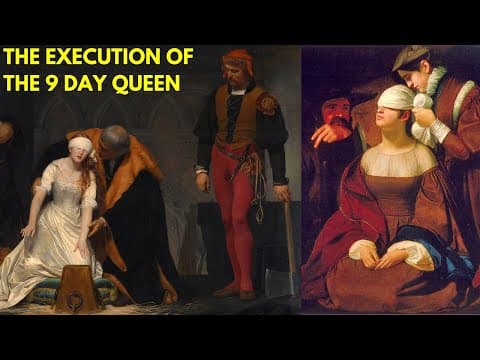
Lady Jane Grey, the Nine Days Queen of England, was executed at just 16 years old. Her brief reign was marked by political manipulation and betrayal, leading to her tragic fate. This blog explores her royal lineage, the events leading to her execution, and the harrowing details of her final moments.
On February 12, 1554, a young woman of around 16 years old made her way to her execution within the walls of the Tower of London. This was not just any commoner; she was Lady Jane Grey, who would later be known as the Nine Days Queen for her brief reign over England from July 10 to July 19, 1553. Today, Jane is often viewed as a victim of the infamous Bloody Mary and the manipulations of powerful men who sought to exploit her royal blood for their own gain.
Lady Jane Grey was born into a family with significant royal connections. She was the great-granddaughter of Henry VII and had royal blood through his youngest daughter, Mary. Additionally, she was a great-niece of the notorious King Henry VIII and a cousin to Edward VI, Mary I, and Elizabeth I. Following the death of Edward VI, Jane was positioned in the line of succession to the throne, as Edward sought to prevent his half-sisters, Mary and Elizabeth, from taking the crown.
After Edward VI's death, Jane was brought to London and proclaimed queen on July 10, 1553. She had recently married Guildford Dudley, the son of the powerful Duke of Northumberland, John Dudley, who was obsessed with consolidating power. While awaiting her coronation, Jane signed several letters as "Jane the Queen," which would later be used against her as evidence of her acceptance of the role.
However, an uprising led by Princess Mary was brewing, and the Privy Council, fearing for their lives, abandoned Jane and supported Mary. Consequently, Jane found herself alone, and Mary was proclaimed the rightful queen.
Following her deposition, Lady Jane Grey was imprisoned in the Tower of London, specifically in the gentleman's jailer's apartments, while her husband Guildford was locked in the Bell Tower. Jane was accused of high treason and stood trial at Guildhall in London. The trial concluded as expected, with Jane being found guilty and sentenced to death.
Mary I, who had known Jane from their childhood, was faced with a difficult decision. The trial stated that Jane's punishment could be either burning alive at Tower Hill or beheading, depending on the queen's preference. Despite some reports suggesting that Mary had reservations about executing her cousin, the Privy Council ultimately advised her to proceed with the execution.
Initially scheduled for February 9, 1554, Jane's execution was postponed for three days to allow her to convert to Catholicism, a request she refused. On the morning of February 12, Guildford Dudley was taken to Tower Hill for his execution. Jane, witnessing her husband's headless corpse being brought back to the tower, screamed his name in despair.
As Jane was led to the execution scaffold, she was helped onto it by the executioner. In her final speech, she addressed the gathered witnesses, stating, "Good people, I am come hither to die, and by a law I am condemned to the same. The fact indeed against the Queen's highness was unlawful, and the consented thereunto by me, by touching the procurement and desire thereof by me or on my behalf, I do wash my hands thereof in innocency before God and the face of you good Christian people this day."
Jane did not admit to any crimes but expressed her innocence. She recited a Psalm and handed her gloves and handkerchief to a maid standing nearby. The executioner, armed with an axe, was asked by Jane to dispatch her quickly. She requested, "Will you take my head off before I lay down?" The executioner replied no, and Jane, blindfolded, began to panic as she could not find the block to rest her head upon.
In her final moments, Jane cried out, "What shall I do? Where is it?" before being guided by the deputy lieutenant of the Tower to the block. Her last words were, "Lord, into thy hands I commend my spirit." The executioner then struck his axe down, and in one blow, Jane's life was ended.
Lady Jane Grey was buried within the Tower of London's chapel. The tragic aspect of her execution lies in her youth; she was merely a teenager when she was executed in private within the fortress. Although she reluctantly accepted the role of queen, she was never coronated and should be remembered as a tragic figure in English history, alongside Mary I and Elizabeth I, as she was indeed a queen.



















