
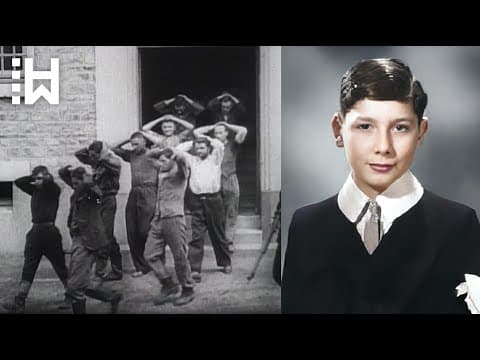
This blog post recounts the harrowing story of Georges-André Kohn, a young Jewish boy and relative of the Rothschild family, who became a victim of Nazi medical experiments and execution during World War II. It details the historical context of Jewish persecution, the family's attempts to evade capture, and the brutal fate that befell Georges and other children at the hands of Nazi doctors.
In 1939, just months before the outbreak of the Second World War, Nazi Germany had already begun its systematic persecution of Jews. Approximately 304,000 Jews had emigrated from Germany, leaving around 214,000 behind. Over six years, Nazi legislation marginalized and disenfranchised Jewish citizens, expelling them from professions and commercial life. Following the war's outbreak on September 1, 1939, Nazi anti-Jewish policies intensified, leading to brutal occupations and collaboration with local regimes across Europe.
Among the most vulnerable were children, who were targeted for various reasons, including supposed racial grounds and alleged political activities. By the end of the war, an estimated 1.5 million Jewish children had been murdered or died at the hands of Nazi officials and their collaborators.
Georges-André Kohn was born on April 23, 1932, in Paris, France, into a wealthy Jewish family. He was the youngest of four children, with two sisters, Antoinette and Rose Marie, and a brother, Philippe. His father, Armand Edouard Kohn, was a relative of the Rothschild banking family and served as the director of the Rothschild Hospital in Paris, the largest Jewish hospital in France. His mother, Suzanne, hailed from one of France's most prominent Jewish families.
As the war began, the Kohn family faced increasing danger. In the summer of 1942, the German regime began deporting Jews from France to death camps. Armand Kohn attempted to protect his family by hiding Jews in his hospital, leveraging his relationship with Alois Brunner, the commandant of Drancy, the main deportation camp in France.
Despite their efforts, the Kohn family was arrested in the summer of 1944 during the final weeks of the German occupation of Paris. They were taken to Drancy, where they awaited deportation to Buchenwald. On August 17, 1944, Georges, then 12 years old, was among 51 people deported in the last transport from Drancy, just a week before Paris was liberated.
During the journey, Georges's siblings, Philippe and Rose-Marie, managed to escape thanks to sabotage by the French resistance. However, Georges was prevented from joining them by his father, who feared for the safety of those left behind.
Upon arrival at Buchenwald, the family was separated. Georges's mother and sister were sent to Bergen-Belsen, where they perished in March 1945. Georges and his grandmother were sent to Auschwitz, where they were also separated shortly after arrival.
In the spring of 1944, Georges was transferred to the Neuengamme concentration camp, where Dr. Kurt Heissmeyer conducted secret medical experiments on children. Heissmeyer sought to test the effects of tuberculosis bacilli injections on human subjects, and by late 1944, he requested Jewish children to serve as "guinea pigs" for his experiments.
Georges was among 20 Jewish children, aged 5 to 12, brought from Auschwitz to Neuengamme. They were housed in barracks and subjected to horrific medical procedures, including infections with live tuberculosis bacilli and surgical removal of swollen glands.
As the war neared its end, the Nazis sought to eliminate evidence of their crimes. On April 20, 1945, Georges and the other children were taken to a basement at Bullenhuser Damm, where they were told they would receive vaccinations. Instead, they were injected with morphine and subsequently hanged by SS men, including Johann Frahm, who infamously remarked that he had "hung the children up on the wall like pictures."
Georges was murdered just three days before his 13th birthday, alongside 19 other children and several adult prisoners who had cared for them.
The war ended on May 8, 1945, but the identities of the victims of the Bullenhuser Damm massacre remained unknown for many years. It wasn't until journalist Günther Schwarberg uncovered the story in the late 1970s that some relatives of the children were located. Philippe Kohn learned of his brother Georges's fate in 1978, 16 years after their father's death.
In 1979, the Children of Bullenhuser Damm association was founded to honor the memory of the murdered children, with Philippe Kohn serving as honorary president. The tragic story of Georges-André Kohn and the 1.5 million other Jewish children murdered during the Holocaust serves as a somber reminder of the atrocities committed during this dark chapter of history.



















