
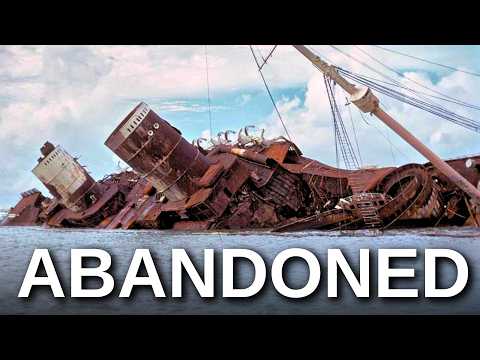
The RMS Queen Elizabeth, once the largest and most luxurious ocean liner, served valiantly during WWII before falling into decline and ultimately being abandoned after a devastating fire in Hong Kong. This blog post explores her illustrious history, tragic fate, and the remnants that remain today.
When she first launched in the late 1930s, the RMS Queen Elizabeth was the pride of the Cunard fleet, known as one of the most lavish, largest, and fastest liners afloat. However, following her service in the 1960s, she would ultimately meet a tragic fate off the coast of Hong Kong, left abandoned for years as a charred wreck. This blog post delves into the iconic ship's life, her sudden demise, and what happened in between.
In the early 1930s, Cunard merged with the White Star Line to become Cunard White Star. Following the launch of the RMS Queen Mary, the world's largest passenger ship at the time, the British government provided funds for a new flagship to accompany her. This new ship, known as hull number 552, would become the RMS Queen Elizabeth.
The Queen Elizabeth was designed to be larger and more technologically advanced than the Queen Mary, with a promise of greater efficiency. Construction began at the John Brown & Company builder yards in Scotland, and after over three years, she was launched in 1938, intended to enter service as a luxury transatlantic passenger liner by 1940.
However, World War II broke out, and fearing that the Germans might target the ship, Cunard was ordered to move her away from the British Isles. Thus, the RMS Queen Elizabeth made a secret maiden voyage to New York City, where she was requisitioned by the British government for war service.
After being fitted out as a troop carrier in Singapore, the RMS Queen Elizabeth served as a reliable troop ship, carrying over 750,000 troops across the Atlantic and sailing over 500,000 miles without a single paying passenger during the war. Winston Churchill praised the ship and her fleetmates for their crucial role in the war effort.
Once the war ended, Cunard took possession of the ship and fitted her out as originally intended. The RMS Queen Elizabeth took her official maiden voyage with paying passengers on October 16, 1946, emerging as a strikingly beautiful and luxurious liner, adorned with the classic Cunard white and black hull and iconic red funnels.
The ship was equipped with luxurious public rooms crafted from over 50 types of rare woods, featuring original paintings, leather tapestries, and brass and velvet furnishings. The RMS Queen Elizabeth boasted 35 public areas, including a cinema and an indoor swimming pool, and her state rooms were designed in beautiful Art Deco fashion.
Throughout the following decades, Cunard and the Queen Elizabeth dominated transatlantic service, becoming iconic vessels for England. In the mid-1950s, the ship underwent updates, including the addition of underwater stabilizers. However, the rise of passenger airlines, particularly with the introduction of the Boeing 707, began to change the landscape of ocean travel.
As passenger numbers declined in the early 1960s, Cunard began sending the Queen Elizabeth on leisure cruises to warmer climates. Despite attempts to modernize the ship, including adding central air conditioning and an aft swimming pool, the aging liner struggled to compete with the efficiency of air travel.
By 1967, Cunard had already retired the RMS Queen Mary, and it became clear that the Queen Elizabeth would also need to be taken out of service. Plans for a successor, known as Project Q4, were underway, and the Queen Elizabeth made her final transatlantic crossing under the Cunard flag in November 1968.
In 1969, Cunard sold a 15% stake in the operational rights of the Queen Elizabeth to a group of businessmen in Philadelphia, who intended to turn her into a museum and hotel ship in Florida. Renamed simply the Elizabeth, the ship opened to the public in February 1969, charging visitors for tours of the former luxury liner.
However, the venture faced numerous challenges, including dissatisfaction from Cunard regarding local government treatment, fire safety concerns, and operational issues. The owners struggled financially, leading to bankruptcy and the ship being auctioned off.
In September 1970, a Chinese businessman purchased the former Queen Elizabeth for around $3.2 million, intending to transform her into a floating university named SSC Wise University. The ship set sail for Hong Kong on February 10, 1971, but technical issues plagued the journey, which took five months instead of weeks.
Upon arrival in Hong Kong, the ship underwent renovations, but on January 9, 1972, disaster struck. A series of fires broke out aboard the liner, quickly growing out of control. Despite firefighting efforts, the ship was deemed a total loss after the fire burned for hours, leading to the collapse of significant portions of the superstructure.
The wreck of the SSC Wise University was left abandoned in Hong Kong Harbor, becoming a navigational and environmental hazard. Salvage crews began removing parts of the wreck, but much of the lower hull remained buried in the mud. By the late 1990s, the area was slated for land reclamation, effectively covering the underwater wreck.
Today, only a few artifacts remain, including the original Q and E metal letters from the ship's nameplate. The wreck was featured in the 1974 James Bond film "The Man with the Golden Gun," symbolizing the ship's legacy.
The RMS Queen Elizabeth's story is one of grandeur, service, and tragedy. From her illustrious beginnings as the largest passenger ship to her tragic end as a burned-out wreck, her legacy remains a poignant reminder of the golden age of ocean liners. While the ship itself may be gone, the memories and artifacts of her past continue to evoke the splendor of a bygone era.



















