
This blog post explores the Trail of Tears and the Indian Removal Act of the 1830s, detailing the policies, key figures, and the devastating impact on Native American tribes, particularly the Cherokees. It examines the historical context, legal battles, and the brutal realities of forced relocation, highlighting the complexities of U.S. government relations with indigenous peoples.
In this lecture, we delve into the Trail of Tears, a tragic chapter in American history marked by the forced removal of Native American tribes from their ancestral lands during the 1830s and early 1840s. This period, driven by policies set forth by President Andrew Jackson, resulted in significant suffering and loss for many indigenous peoples. This post aims to provide a thorough understanding of the events surrounding the Indian Removal Act, the key tribes involved, and the broader implications of these actions.
Before the Indian Removal Act, various policies governed the relationship between the U.S. government and Native American tribes. The British established the first official reservation in 1758, aiming to prevent settler encroachment. Following the American Revolution, the newly formed United States adopted a treaty system, treating tribes as sovereign nations. However, this system gradually shifted towards a more aggressive approach to land acquisition.
Thomas Jefferson, during his presidency, advocated for the assimilation of Native Americans into white society, promoting intermarriage and agricultural practices. This approach was rooted in the belief that Native Americans could become "civilized". However, the reality was that many tribes resisted these changes, leading to increasing tensions.
With Andrew Jackson's presidency, the attitude towards Native American tribes shifted dramatically. Jackson garnered enough support to pass the Indian Removal Act in 1830, which aimed to relocate tribes living east of the Mississippi River to designated Indian Territory in present-day Oklahoma. The act faced significant opposition, passing narrowly in Congress, reflecting deep divisions along party and sectional lines.
The initial focus of the Indian Removal policy was on the so-called Five Civilized Tribes: the Cherokees, Creeks, Choctaws, Chickasaws, and Seminoles. These tribes had adopted various aspects of European-American culture, including farming and governance, yet they were still targeted for removal.
The removal process was brutal and often chaotic. The Choctaws were the first to be forcibly relocated, suffering greatly during their journey due to disease and lack of resources. The Creeks faced similar challenges, as their lands were gradually whittled down through treaties that favored American settlers.
The Cherokees, in particular, sought to prove their civilization by adopting a constitution similar to that of the United States. However, their efforts were met with hostility from the state of Georgia, which sought to undermine their sovereignty. The discovery of gold in Cherokee territory intensified pressures for removal, leading to a series of legal battles.
The Cherokees pursued legal avenues to protect their rights, resulting in landmark Supreme Court cases such as Cherokee Nation v. Georgia and Worcester v. Georgia. While these rulings affirmed their sovereignty, President Jackson refused to enforce them, leading to the inevitable removal of the Cherokees.
In 1835, a controversial treaty was signed by a minority of Cherokee leaders, ceding all Cherokee lands to the U.S. in exchange for relocation assistance. This treaty was not recognized by the majority of the Cherokee Nation and was ratified by Congress despite significant opposition. The forced removal began in 1838, leading to the infamous Trail of Tears.
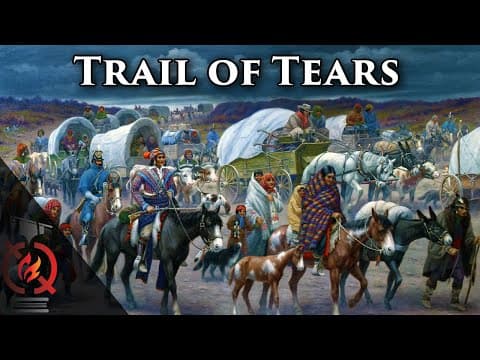
The Trail of Tears refers to the harrowing journey of the Cherokees as they were forcibly marched to Indian Territory. Approximately 4,000 Cherokees died from disease, exposure, and starvation during this journey. The U.S. Army, tasked with overseeing the removal, often resorted to internment camps, which further exacerbated the suffering of the displaced tribes.
While the Cherokees faced the most notable removal, other tribes also experienced significant hardships. The Seminoles in Florida resisted removal through armed conflict, leading to the Second Seminole War, which became one of the costliest conflicts for the U.S. government.
In the Old Northwest, the Black Hawk War erupted as various tribes united under the leadership of Black Hawk to resist removal. This conflict highlighted the desperation of Native Americans to retain their lands and way of life.
The Indian Removal Act and the subsequent Trail of Tears represent a dark period in American history, characterized by the systematic displacement and suffering of Native American tribes. The policies enacted during this time fundamentally altered the relationship between the U.S. government and indigenous peoples, leading to long-lasting consequences that are still felt today. Understanding this history is crucial for acknowledging the injustices faced by Native Americans and the ongoing struggles for their rights and recognition.



















