This blog post explores the remarkable transformation of Macau from a sleepy backwater to the world's gambling capital, driven by Stanley Ho's vision and the city's unique blend of cultures. It discusses the architectural evolution, the impact of land reclamation, and the future direction of Macau as it seeks to balance tourism with the needs of its residents.
In 1941, a 19-year-old man fleeing the Japanese occupation of Hong Kong arrived on the islands of Macau with nothing but the clothes on his back and $2 in his pocket. This man, Stanley Ho, would go on to change the city forever, earning the title of the Gambling King of Macau. His story is intertwined with the rise of one of China’s most intriguing cities, marked by a unique blend of cultures and architectural styles.
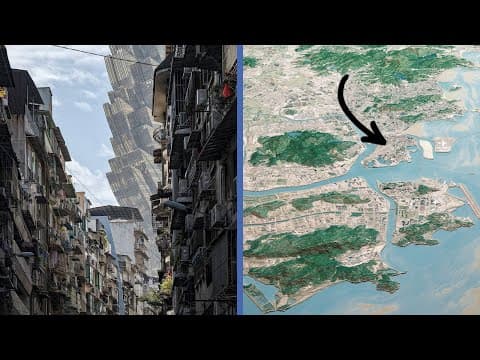
When Stanley Ho arrived in Macau, it was a sleepy backwater. However, by the time he left, he had transformed it into a bustling metropolis and the gambling capital of the world, surpassing even Las Vegas. Macau is a city of contradictions: gambling is illegal in mainland China, yet its gaming industry is seven times larger than that of Las Vegas. It is the most densely populated place in the world, yet over two-thirds of it is built on reclaimed land.
Macau's identity is shaped by its history as a Portuguese colony and its current status as part of China. This duality is reflected in its architecture and urban planning. Unlike Hong Kong, which followed a different trajectory under the “one country, two systems” policy, Macau embraced gambling and other vices to boost its economy. Legalizing the gaming industry in the 1850s was a pivotal moment that set the stage for its future.
Since the 17th century, Macau has utilized land reclamation to expand its territory. The first significant project was a land bridge connecting the largest island of Macau to mainland China. By 1912, Macau consisted of just two islands covering 11.6 square kilometers. The space between these islands was filled through a process called infilling, where rocks were piled and clay was used to raise the land above sea level. This technique would be perfected over the next century.
Stanley Ho, born into a wealthy family that lost everything during the Great Depression, arrived in Macau with a vision. After trading military supplies and kerosene, he established himself as an entrepreneur while eyeing the potential of the gaming industry. By the 1960s, he had gained an exclusive gambling license, creating a monopoly that lasted for four decades. His flagship project, the Casino Lisboa, opened in 1970 and was a groundbreaking establishment that set the tone for Macau's future.
The Casino Lisboa was a dazzling spectacle, featuring bold neon lights and a golden facade. It became one of the largest and most profitable casinos in the world. However, the city's infrastructure struggled to keep pace with its newfound popularity, leading to a construction boom. Ho also pioneered a ferry system to bring wealthy visitors from Hong Kong and the mainland, further boosting the economy.
In 1999, Macau was handed over to the People’s Republic of China, marking the end of Portuguese rule. This transition brought new challenges as Ho's monopoly was lifted in 2002, allowing competitors like Wynn Resorts and MGM to enter the market. In response, Ho expanded the Casino Lisboa and opened the Grand Lisboa in 2007, a luxurious tower designed to assert his dominance in the evolving landscape.
The Grand Lisboa, designed by architects Dennis Lau and Ng Chun Man, was a bold statement of luxury and opulence. Its design drew inspiration from blooming lotus flowers and featured a golden crown-like structure, symbolizing wealth and fortune in Chinese culture. Inside, it housed 430 luxury rooms and over 1,000 slot machines, reinforcing Macau's status as a premier gambling destination.
In contrast, the Morpheus Hotel, built by Ho's rivals, represented a new era of luxury. Designed by Zaha Hadid, it featured a unique exoskeleton structure and was one of the first large-scale constructions to utilize 3D printing technology. This innovative approach allowed for expansive interior spaces and showcased the evolution of architectural design in Macau.
Stanley Ho retired in 2018 and passed away in 2020, leaving behind a transformed city. Today, Macau continues to cater to tourists but is also shifting its focus towards attracting luxury seekers. The New Macau Urban Zone project aims to add 7.3 square kilometers of land, primarily for housing developments, addressing the needs of its residents.
With a population of around 700,000 and 32 million visitors annually, Macau is the most densely populated place in the world. The challenge now lies in balancing tourism with the needs of its citizens. The legacy of the Gambling King lives on, but the future of Macau may depend on its people shaping the city for their own needs, rather than solely for tourists.
In conclusion, Macau is a vibrant, contradictory place full of drama, reflected not only in its architecture but also in its ongoing evolution. As the city moves forward, it may find that the next king is not a single individual but the collective voice of its residents, striving to create a city that serves them first.