
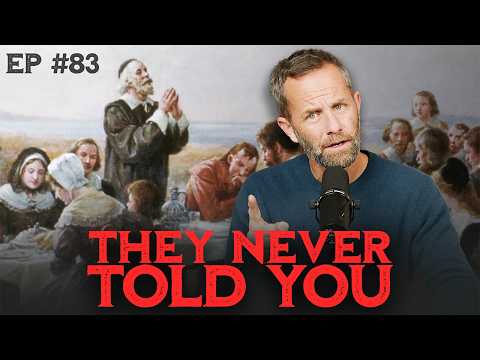
Thanksgiving's true origin is rooted in the faith and perseverance of the Pilgrims, who fled religious persecution, endured harsh winters, and relied on divine providence and Native American assistance to survive. Contrary to popular myths, Thanksgiving commemorates a day of gratitude to God for mercy and survival, not colonization or genocide. This story highlights the foundational values of faith, freedom, and gratitude that shaped America.
Thanksgiving is often remembered as a festive holiday filled with turkey, stuffing, and cranberry sauce. However, the real story behind Thanksgiving is far more profound and rooted in faith, hardship, and divine mercy. This article explores the true origins of Thanksgiving, dispelling common myths and revealing the courageous journey of the Pilgrims who laid the foundation for America.
Many believe that America’s beginning involved pilgrims arriving and immediately taking land by force, engaging in pillaging and destroying indigenous cultures. Some narratives even claim that early settlers celebrated days of thanks for acts of genocide. These versions, often promoted by certain political or cultural agendas, paint a distorted picture of history.
The truth is quite different. America was born in faith, cold winds, starvation, tears, and prayer. The first Thanksgiving was not a feast but a solemn cry of a people who nearly died and were saved by the mercy of Almighty God.
The story begins in a small English village called Scrooby, where ordinary believers—moms, dads, and children—gathered secretly to worship God and read the Bible. These separatists had broken away from the Church of England, seeking religious freedom and peace.
However, their faith collided with the tyranny of King James I, who claimed absolute control over his kingdom and persecuted those who disobeyed him. Ministers were mutilated, imprisoned, or executed. The separatists faced harassment and imprisonment simply for worshiping outside the king’s church.
In 1607, to escape persecution, the separatists sold everything and planned a secret trip to Holland, where they hoped to find religious freedom. However, their journey was betrayed by a Dutch ship captain who handed them over to the king’s soldiers. The women and men were publicly humiliated, searched, and imprisoned in harsh conditions where many men died from disease and starvation.
Despite these hardships, the survivors did not give up. They planned a second escape, but again faced betrayal and imprisonment before finally reuniting in Holland.
In Holland, the pilgrims found spiritual freedom and learned principles of civil liberty, economic freedom, and religious liberty rooted in the Bible and English common law. Yet, life was difficult. They faced economic hardship, cultural threats to their faith, and the looming threat of a Spanish invasion.
Faced with these challenges, the pilgrims made the bold decision to venture across the Atlantic Ocean to the New World, seeking a place where they could freely worship God and raise their children in faith.
The pilgrims boarded two ships, the Speedwell and the Mayflower. The Speedwell proved unseaworthy, forcing many to remain behind. The Mayflower’s voyage was treacherous, lasting 66 days amid storms, sickness, and fear.
They were pushed off course to Cape Cod, outside their chartered territory, and realized they had to govern themselves. They drafted and signed the Mayflower Compact on November 11, 1620, a covenant beginning “in the name of God, Amen.” This document established a government based on mutual consent and biblical principles, laying groundwork for future American governance.
Upon arrival, the pilgrims found an abandoned Native American village, but the winter was brutal. Half of the colonists died by March, with some mothers found dead over their frozen children. They buried their dead in unmarked graves to avoid appearing weak to surrounding tribes.
Their survival was aided by Squanto, a Native American who spoke perfect English. Kidnapped earlier by English explorers and educated in England, Squanto returned to find his tribe wiped out by plague. Instead of harboring hatred, he helped the pilgrims by teaching them how to farm, fish, and hunt, and acted as an interpreter and mediator.
Through Squanto, the pilgrims established a 50-year peace treaty with Massasoit, chief of the neighboring Wampanoag tribe, ensuring mutual protection and justice.
Initially, the pilgrims were forced into communal farming by their financial backers, a socialist model that led to starvation and resentment. Governor William Bradford eventually abandoned this system, assigning private land to families. Productivity soared as people worked for the fruit of their own labor, reflecting biblical principles of personal responsibility and free markets.
Just as conditions improved, a severe drought threatened their survival. With no food reserves, the pilgrims fasted, prayed, and repented, turning their hearts back to God. On the day of their prayer and fasting, rain came gently and abundantly, reviving their crops.
Governor Bradford recorded this event as a miraculous mercy from God. In gratitude, the pilgrims set aside a day of thanksgiving—not a feast first, but a day dedicated to giving thanks to God for His providence and mercy. This was the first true Thanksgiving.
Thanksgiving is not merely a historical event but a mirror reflecting the values of faith, courage, gratitude, and freedom. The pilgrims’ story reminds us that freedom costs everything and that faith requires risk.
In today’s world, where many have forgotten the true meaning of Thanksgiving, it is vital to remember that it was God, not government, who made this nation free and prosperous. The pilgrims’ legacy challenges us to choose faith over comfort, truth over safety, and reliance on God over reliance on government.
This Thanksgiving, be intentional in sharing the true story of the pilgrims—their persecution, their courage, their faith, and their gratitude. Remember the sacrifices of those who came before us and the God who carried them through storms and droughts.
As Scripture instructs, do not worry but pray about everything, give thanks for all that God has done, and experience His peace. May this Thanksgiving be a time of genuine gratitude and reflection on the providential foundation of our freedom.
Happy Thanksgiving, and may God bless you, your family, and our nation.



















