
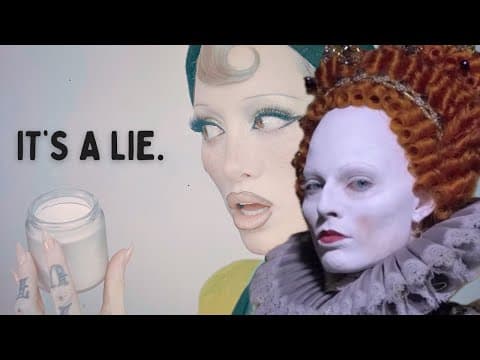
This blog post explores the historical use of lead-based makeup by Queen Elizabeth I, examining the myths surrounding her appearance and the toxic effects of such cosmetics. It delves into the portrayal of Elizabeth in art and media, the lack of contemporary evidence for her makeup use, and the implications of sexism in historical narratives.
Join us as we travel across the world to uncover the truth behind one of the deadliest makeup ingredients that has been used for centuries. This investigation focuses on Queen Elizabeth I, often depicted with heavy white makeup loaded with lead. Did she really wear such toxic cosmetics, or is this just a myth perpetuated by Hollywood? In this exploration, we will unravel the facts and fiction surrounding Queen Elizabeth's appearance and the implications of her cosmetic choices.
Queen Elizabeth I, known as the Virgin Queen, was crowned in 1558. She was celebrated for her long auburn hair, subtly rouged cheeks and lips, and fair skin that seemed almost translucent. However, just a few years into her reign, Elizabeth contracted smallpox, a disease that left her with significant scarring. The severity of smallpox is alarming, with symptoms including high fever, nausea, and a blistering rash that could lead to permanent scars.
In the wake of her smallpox infection, it is believed that Elizabeth began using a heavy white lead-based makeup to cover her scars. This makeup, known as Venetian ceruse, was highly toxic and contributed to the deterioration of her skin, leading to a gray, wrinkled appearance. This narrative has been popularized in films and art, but is it accurate?
Art historian Sir Roy Strong coined the term "the mask of youth" in the 1970s to describe how Elizabeth was portrayed in portraits. Prior to this, depictions of her varied significantly. The question arises: have we been misled by Hollywood's portrayal of Elizabeth? The stark contrast between earlier and later representations raises doubts about the authenticity of her supposed heavy makeup.
During a visit to the National Portrait Gallery in London, the examination of Elizabeth's portraits revealed that while some showed a fair complexion, they did not necessarily depict her as heavily made up. The Phoenix portrait, created when she was around 60, shows her with a fair complexion but lacks the exaggerated white makeup often associated with her. In contrast, portraits of actresses from the 1600s clearly display the use of cosmetics, suggesting that Elizabeth's portrayal may have been more natural than previously thought.
Elizabeth's wax effigy, created after her death, also provides insight into her true appearance. This effigy was so lifelike that it caused gasps among onlookers, yet it did not exhibit the heavy white makeup that has become synonymous with her image. Instead, it presented a more realistic skin tone, further questioning the narrative of her using toxic cosmetics.
Beauty historian Lucy James Santos, an expert on toxic cosmetics, noted that there is no contemporary evidence to support the claim that Elizabeth wore thick white makeup. The only account comes from a Jesuit priest, Father Rivers, who had a biased perspective and did not witness Elizabeth firsthand. His unreliable testimony raises further doubts about the historical accuracy of Elizabeth's makeup use.
To understand the effects of lead-based cosmetics, a visit to Professor Fiona McNeel at McMaster University provided valuable insights. Professor McNeel has studied lead poisoning for over 30 years and conducted experiments with historical lead makeup recipes. Surprisingly, the lead makeup did not appear as the heavy white paint commonly imagined. Instead, it provided a subtle glow and smoothing effect on the skin, resembling modern-day illuminators rather than a thick mask.
The narrative surrounding Queen Elizabeth I's use of toxic makeup is steeped in myth and sexism. Historical accounts of her appearance have often been exaggerated or misrepresented, particularly in the context of 19th-century attitudes towards powerful women. Elizabeth faced immense challenges throughout her life, and the focus on her appearance detracts from her accomplishments as a ruler. As we continue to explore the truth behind her cosmetics, it becomes clear that the image of Elizabeth as a painted clown is a distortion of reality, rooted in societal biases rather than historical fact.
In the next part of this exploration, we will delve deeper into the toxicity of lead makeup and its historical implications. We will also attempt to recreate lead makeup to understand its effects firsthand. Stay tuned for more revelations about the cosmetics that shaped history and the women who wore them.



















