
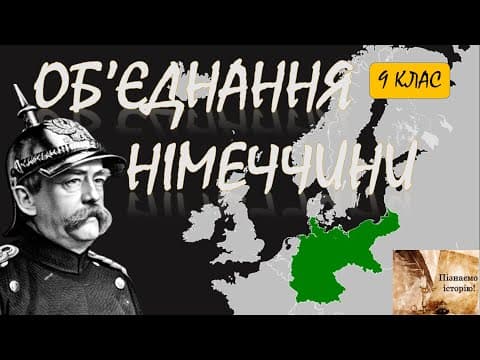
This blog post explores the complex historical events leading to the unification of Germany, detailing the political struggles, wars, and key figures involved in the process from the early 19th century to the establishment of the German Empire in 1871.
The unification of Germany is a significant event in European history, marking the transformation of numerous independent states into a single nation. This blog post delves into the historical context, key events, and influential figures that shaped this monumental change.
At the beginning of the 19th century, the Napoleonic Wars led to the dissolution of the Holy Roman Empire. Napoleon Bonaparte initiated the formation of the Rhine Confederation, which included various German territories. Following Napoleon's defeat, the Congress of Vienna in 1815 established the German Confederation, comprising 35 independent German monarchies, four free cities, and parts of Prussia and Austria.
The wave of revolutions in Europe during 1848, known as the Springtime of Nations, also affected the German states. A Frankfurt Parliament was convened, and a constitution was adopted aiming for the unification of all German lands into a single state. However, the efforts were thwarted by the Prussian king, who opposed the parliament's decisions. At that time, Austria and Prussia held significant influence, each wanting to maintain its dominance in the event of unification.
Two main paths for unification emerged: the small German solution led by Prussia and the large German solution led by Austria. The northern German states leaned towards Prussia, leading to the formation of the National Union in 1859, which favored the small German path. In contrast, the southern German states supported Austria.
The political landscape shifted with the ascension of Wilhelm I as the new monarch of Prussia and Otto von Bismarck as the Prime Minister. Bismarck was determined to unify Germany through a policy he famously described as "iron and blood," relying heavily on military strength. This approach inevitably led to conflict.
In 1866, Prussia withdrew from the German Confederation and initiated a war against Austria. The conflict resulted in a decisive Prussian victory, leading to the dissolution of the German Confederation. Austria relinquished its claim to supremacy over the German territories, and Prussia annexed several northern German lands, forming the North German Confederation in 1867.
Following the war with Austria, relations between Prussia and France deteriorated. Bismarck believed that a war with France was imminent and sought to provoke French Emperor Napoleon III into declaring war. This strategy succeeded, and France declared war on Prussia.
Prussia was well-prepared for the conflict, and the war quickly turned in their favor. French forces were encircled near the towns of Metz and Sedan, with the latter becoming a catastrophic defeat for France. Napoleon III was captured, leading to the proclamation of the Third Republic by the Parisians, who felt they no longer needed a king.
As Prussian troops advanced towards Paris, France was compelled to seek an armistice and sign a peace treaty. The war concluded triumphantly for Prussia, culminating in the proclamation of the German Empire in January 1871 at the Hall of Mirrors in the Palace of Versailles. Wilhelm I was declared the Emperor, and the new empire included all German states under a constitution that established Germany as a constitutional monarchy and a federation.
The unification of Germany was a complex process influenced by wars, political maneuvering, and the ambitions of key leaders. The establishment of the German Empire marked a pivotal moment in European history, reshaping the continent's political landscape and setting the stage for future conflicts and developments.



















