
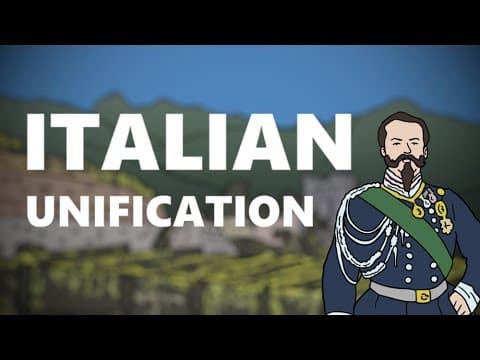
Italy's unification in 1861 was the result of centuries of internal strife, foreign invasions, and the efforts of key figures like Giuseppe Mazzini, Camillo Cavour, and Giuseppe Garibaldi. This blog post explores the historical context, key events, and challenges faced by the newly unified Italian state.
On March 17th, 1861, Italy was finally united under one king after centuries of invasion and internal strife. This blog post delves into the historical context that led to the creation of a unified Italian state, exploring the key figures and events that shaped this monumental change.
Historically, Italians identified more with their respective city-states rather than a distinct Italian nationality. These city-states were often governed by foreign powers. By the dawn of the Renaissance, independent regional states began to emerge, eager to advance their own interests and frequently waging war against one another. During invasions, they sometimes allied with foreign invaders, turning Italy into a battleground for the armies of Spain, France, and the Holy Roman Empire.
The 16th and 17th centuries marked a cultural rebirth in northern Italy, with figures like Dante Alighieri, Niccolò Machiavelli, and Cesare Borgia laying the groundwork for a national consciousness. However, as the Renaissance waned, Italy became overshadowed by the colonial powers of Europe, leading to a decline in its cities' wealth and status.
The period from the 1700s to the early 1800s is often referred to as "The Forgotten Centuries." This relative calm was shattered by Napoleon's invasion, which introduced liberal ideas and sparked a minor Industrial Revolution. The aftermath of Napoleon's defeat saw a rise in nationalist sentiments among the Italian elite, leading to the formation of secret societies advocating for unification.
After Napoleon's final exile in 1815, Italy was fragmented. Naples was under Bourbon rule, while Tuscany, Milan, and Venice were controlled by the Austrians. During this time, many Italians began to see the benefits of a centralized government, similar to what they experienced under Napoleon. The Industrial Revolution further fueled the desire for improved infrastructure and economic connectivity.
Several influential figures emerged during this period:
Despite their differing ideologies and mutual distrust, these three figures significantly advanced the cause of Italian unification.
The revolutionary fervor of 1848 saw uprisings across Italy, with Milan and Venice revolting against Austrian rule and Naples rising against the Bourbons. In response, Charles Albert, the king of Piedmont-Sardinia, declared war on Austria, marking the beginning of the First Italian War of Independence. However, internal divisions and early withdrawals led to an Austrian victory.
The Second Italian War of Independence broke out in 1859, with Piedmont-Sardinia securing a secret pact with France. Cavour provoked Austria into conflict, leading to significant territorial gains for Italy, although the French later negotiated terms that favored Austria.
Garibaldi's expedition to Sicily in 1860 further expanded Italian territory, culminating in the annexation of Naples and Sicily. By 1861, most Italian territories were united under King Victor Emmanuel II, although Rome and Venice remained outside of this union.
The Third Italian War of Independence, part of the Austro-Prussian War, resulted in the acquisition of Venice. The final unification occurred in 1870 when French troops withdrew from Rome following their defeat in the Franco-Prussian War, allowing Italy to capture the city and complete its unification.
Despite the successful unification, the newly formed Italian state faced significant challenges. The middle class and aristocracy were not fully committed to the revolutionary ideals that had driven the unification process. The Italian parliament experienced gridlock as socialists and liberals struggled to find common ground.
As noted by historian Serge Hughes, the leaders of the Risorgimento proclaimed, "Now that we have made Italy, we must make Italians." However, decades passed, and Italians remained as disunited as ever, a challenge that would continue to affect Italy throughout the 19th century and beyond.
The unification of Italy was a complex process shaped by historical events, influential figures, and the socio-political landscape of the time. While the creation of a unified Italian state marked a significant achievement, the challenges that followed highlighted the difficulties of forging a cohesive national identity. The legacy of these events continues to resonate in Italy today.



















