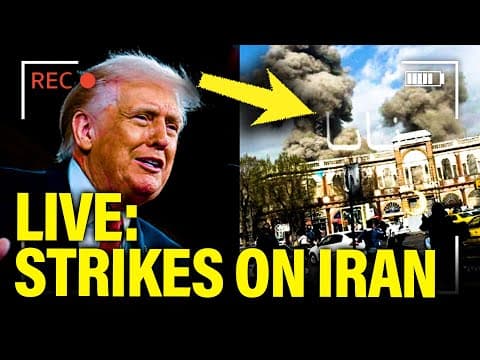
A joint military operation by the United States and Israel, named Operation Hand in Hand or Operation Roaring Lion, has commenced with strikes targeting Iran's key military and government facilities. The strikes follow failed diplomatic negotiations and have led to retaliatory missile attacks by Iran on multiple Middle Eastern countries, escalating the conflict into a broader regional war with significant geopolitical implications.
In a significant escalation of tensions in the Middle East, the United States and Israel have launched a joint military operation against Iran, targeting key military and government facilities in Tehran and other cities. The operation, initially called "Operation Hand in Hand" and later referred to as "Operation Roaring Lion" by Israel and "Operation Epic Fury" by the U.S., involves assassination and decapitation strikes aimed at crippling Iran's leadership and military capabilities.
Israeli media and multiple independent sources, including the New York Times and Wall Street Journal, have confirmed the joint nature of the operation. The strikes began early in the morning local time and are expected to continue for several days.
The initial wave of strikes targeted areas in Tehran such as University Street and John Marai, with reports of explosions and smoke rising from these locations. Key government facilities, including intelligence headquarters and the presidential palace, have been hit. Unconfirmed reports suggest that senior Iranian military officials, including the defense minister and the head of the judiciary, may have been targeted or killed.
Iran's Supreme Leader has reportedly been moved to a secure location and survived the initial strikes. The operation is described as a decapitation campaign aimed at removing the regime's leadership.
In response, Iran has launched ballistic missile attacks targeting Israel, Bahrain, the United Arab Emirates (UAE), Qatar, Kuwait, and other Gulf countries. The Israeli Defense Forces (IDF) have activated air defense systems, including the Iron Dome, to intercept incoming missiles. Sirens and missile alerts have been sounded across Israel and other affected countries.
Significant explosions have been reported near the U.S. naval base in Bahrain, a critical logistics and operations hub for U.S. naval forces in the region. Additional missile attacks have targeted U.S. bases in Qatar and Kuwait, with some missiles intercepted and others causing damage.
The Houthi militia in Yemen has announced its intention to join the conflict on Iran's side, resuming attacks on shipping routes in the Red Sea and threatening to close the Strait of Hormuz, a vital passage for global oil supply.
Prior to the strikes, diplomatic efforts were underway to reach an agreement on Iran's nuclear program. The Omani Foreign Minister, Badar Al-Busaidi, who acted as a mediator, reported significant progress in negotiations, with Iran agreeing to unprecedented terms such as zero stockpiling of enriched uranium and full verification by the International Atomic Energy Agency (IAEA).
Technical talks were scheduled to resume, aiming to finalize an agreement that would prevent Iran from developing nuclear weapons. However, the U.S. and Israel proceeded with the military operation despite these diplomatic efforts.
Former President Donald Trump released a video statement on his social media platform, Truth Social, announcing the commencement of major combat operations against Iran. He cited the need to defend the American people from threats posed by the Iranian regime, which he described as a state sponsor of terror responsible for attacks on U.S. forces and allies.
Trump emphasized the objective of preventing Iran from obtaining nuclear weapons and called on Iranians to take control of their government, urging them to seize the opportunity for freedom.
Netanyahu expressed gratitude to Trump for his leadership and framed the operation as necessary to remove the existential threat posed by Iran. He called on the Iranian people to cast off tyranny and promised unity and strength in the face of the conflict.
The operation has sparked widespread concern and condemnation. Critics highlight the lack of clear explanation or congressional authorization for the war, emphasizing the risks to American troops and regional stability.
There is skepticism about the true objectives of the operation, with some suggesting that regime change, rather than solely preventing nuclear proliferation, is the primary goal. The potential for a prolonged conflict raises questions about the availability of military resources and the impact on global markets, including oil prices and inflation.
The conflict has rapidly expanded across the Middle East, with multiple countries experiencing missile attacks and heightened military activity. The closure or disruption of the Strait of Hormuz could have severe consequences for global energy supplies.
Allied nations have expressed concern, and some have begun evacuating embassy staff. The situation remains fluid, with ongoing missile launches and air defense operations.
The strikes and ensuing conflict have significant humanitarian implications. The Iranian people, already living under a repressive regime, face increased danger amid the military actions. Previous calls for protests against the Iranian government resulted in thousands of deaths, raising fears about the consequences of renewed unrest.
The joint U.S.-Israeli military operation against Iran marks a dramatic escalation in Middle Eastern tensions, with widespread regional impact and uncertain outcomes. The failure of diplomatic negotiations and the initiation of military strikes have plunged the region into conflict, with significant risks for global security and stability.
As the situation develops, the international community watches closely, hoping for a resolution that avoids further bloodshed and promotes peace.
This comprehensive overview reflects the unfolding events and the complex geopolitical dynamics at play, emphasizing the gravity of the situation and the urgent need for informed public discourse and responsible leadership.