
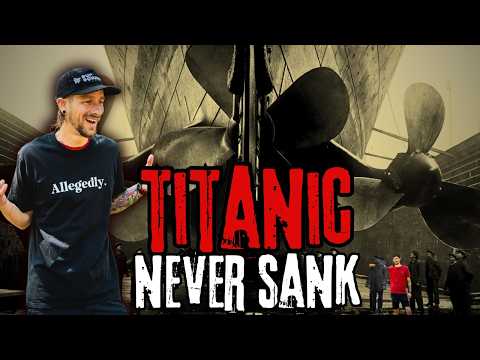
The Titanic's tragic sinking has captivated audiences for over a century, but new theories suggest it may not have been the Titanic that sank at all. This article explores the possibility that the ship that went down was actually its sister ship, the Olympic, and delves into the historical context, key figures, and conspiracy theories surrounding this maritime disaster.
Everyone knows the story of the Titanic, the largest moving object ever created by man, which tragically sank on its maiden voyage after hitting an iceberg, resulting in the loss of 1,500 lives. This well-documented tragedy has been immortalized in books and films, yet it continues to raise questions. What if the ship that sank was not the Titanic, but its sister ship, the Olympic? This article explores this compelling hypothesis and the mysteries surrounding the Titanic disaster.
In April 1912, the Titanic embarked on its maiden voyage, boasting luxurious amenities and considered practically unsinkable due to its watertight compartments. However, on a cold night, it struck an iceberg and vanished beneath the waves. The story of the Titanic is often told through the lens of the 1997 film starring Leonardo DiCaprio and Kate Winslet, which, while emotionally powerful, may not accurately represent the historical events.
The media coverage of the Titanic disaster was rife with conflicting information. Newspapers reported various accounts, sometimes declaring individuals dead before their bodies were recovered. The only reliable accounts came from survivors, with 63 testimonies forming the basis of Walter Lord's 1955 book, "A Night to Remember." This book became the accepted narrative of the Titanic's fate, but it raises questions about the accuracy of the historical record.
Interestingly, a novel titled "The Wreck of the Titan" was published in 1898, which eerily parallels the Titanic's story. The fictional ship, Titan, was also deemed unsinkable and met a similar fate. This raises the question: was this merely a coincidence, or did it serve as a prophetic warning?
The Titanic was the second of three ships built by the White Star Line, following the RMS Olympic. The Olympic had a troubled history, including a collision with the HMS Hawk, which required extensive repairs. As the Titanic was nearing completion, the Olympic's issues led to a rush to finish the Titanic, resulting in skipped safety tests and potential compromises in construction quality.
While the Titanic and Olympic were nearly identical, there were subtle differences, such as the design of the wheelhouse and the number of portholes. Notably, the Titanic had 14 portholes, while the Olympic had 16. This discrepancy raises questions about the ship that actually set sail in April 1912.
As the Titanic set sail, it was under pressure to make good time, leading to a speed that may have contributed to its collision with the iceberg. On the night of April 14, 1912, the ship received warnings about icebergs but failed to heed them. The ship struck an iceberg, leading to a catastrophic flooding of compartments and ultimately its sinking.
The SS Californian was nearby and reportedly saw distress signals from the Titanic but did not respond. This raises suspicions about the actions of its captain, Stanley Lord, and whether there was a deliberate decision to ignore the Titanic's plight.
Some theorists suggest that the Titanic that sank was actually the Olympic, swapped to claim insurance money. This theory is bolstered by the fact that both ships were built in the same dry dock and underwent similar repairs. Evidence includes the condition of the wreckage and discrepancies in the ship's identification numbers.
JP Morgan, who had significant financial interests in both ships, insured them for $1 million each. The sinking of the Titanic could have been a calculated move to eliminate competition and secure financial gain, especially given the opposition to the Federal Reserve Act from several wealthy individuals aboard the ship.
The Titanic disaster remains one of the most captivating maritime tragedies in history. The possibility that the ship that sank was not the Titanic but the Olympic adds a layer of intrigue to an already complex narrative. As we continue to explore the depths of this mystery, we are reminded of the power of storytelling and the enduring fascination with the Titanic's legacy.
In the end, whether it was the Titanic or the Olympic that sank, the tragedy serves as a poignant reminder of human hubris and the fragility of life at sea.



















