
This blog post explores the historical attempts by Russia to invade India during the 18th and 19th centuries, detailing the geopolitical motivations, plans, and failures of these invasions, as well as their implications for India and the British Empire.
The golden rule of geopolitics states that no one is a permanent enemy and no one is a permanent friend. Interests shift over time, and history has shown us that nations often reconsider their alliances and enmities based on changing circumstances. One lesser-known chapter in this narrative involves Russia's attempts to invade India during the 18th and 19th centuries. This blog post delves into the historical context, the motivations behind these invasions, and the outcomes of Russia's plans to assert its influence in the Indian subcontinent.
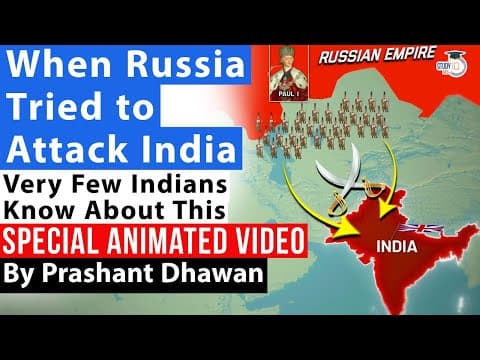
In the early 18th century, India was seen as a land of immense wealth, often referred to as the "golden bird." The British were gradually establishing their dominance, colonizing the region and extracting its resources. Observing this, Russian Emperor Paul I recognized the potential for Russia to intervene and prevent the British Empire from gaining further strength.
In the early 1800s, Paul I proposed an alliance with French Emperor Napoleon Bonaparte. The plan was to create a formidable military force comprising Russian and French soldiers to march into India and oust the British. Detailed discussions took place regarding troop movements and strategies, with plans for 70,000 soldiers to invade India. However, Napoleon ultimately rejected the proposal, leading Paul I to decide to send 22,000 soldiers independently. Unfortunately, logistical issues and the assassination of Paul I thwarted these plans, marking the first failed attempt.
Following the assassination of Paul I, his successor, Alexander I, also sought to challenge British dominance in India. He proposed a treaty with Napoleon, which aimed to divide the eastern and western parts of the world between Russia and France. However, by this time, the British had become aware of Russian intentions and strengthened their diplomatic ties with Persia, preventing Russian troops from passing through Persian territory to reach India. This diplomatic maneuvering led to the failure of the second invasion attempt.
After a 40-year hiatus, Russia's ambitions resurfaced in the mid-19th century during what is known as the Great Game—a geopolitical struggle between the British and Russian Empires. General Alexander Sergeyevich Duhamel, a key figure in this period, proposed a new plan to invade India through Persia and Afghanistan. He believed that the Indian populace was discontent with British rule, as evidenced by the 1857 rebellion led by figures like Mangal Pandey. However, the outbreak of the Crimean War between the Ottoman Empire and Russia diverted Russian resources and attention, leading to the failure of this third attempt.
In 1855, General Krul proposed a different strategy, suggesting that Russia should train Afghan tribal leaders to rise against the British. This plan was considered but ultimately rejected due to the ongoing Crimean War, which required Russian troops to remain focused on their conflict with the Ottomans. Thus, the fourth attempt also failed, marking the end of Russia's direct military ambitions in India.
The series of failed attempts by Russia to invade India highlights the complex interplay of geopolitics during the 18th and 19th centuries. Each plan was thwarted by a combination of logistical challenges, diplomatic maneuvers by the British, and the shifting priorities of Russian leadership. While these invasions never materialized, they reflect the broader struggle for power and influence in the region, ultimately shaping the course of Indian history.
The question remains: what if Russia had succeeded in its attempts? Would India have experienced a different colonial legacy under Russian rule? These hypothetical scenarios invite further discussion and debate about the implications of imperial ambitions and the fate of nations caught in the crossfire of great power rivalries.



















