
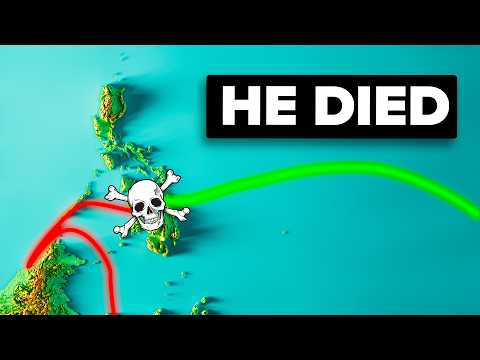
Ferdinand Magellan is often credited as the first to circumnavigate the globe, but he died before completing the journey. In fact, his slave, Enrique de Malacca, may have circumnavigated the world over a year earlier, raising questions about the true first circumnavigation.
Everyone knows that Ferdinand Magellan was the first person to circumnavigate the globe. However, what if we told you that you’ve been misled your entire life? Magellan died in the Philippines and never made it back to Spain. Out of the 270 men who set sail on the expedition, only 18 completed the journey. The astonishing revelation is that one man may have circumnavigated the world a year and four months prior to the Magellan expedition, successfully returning to Europe. So, who was this mysterious explorer, and why has history overlooked him?
To understand the context of Magellan's voyage, we must start at the beginning. Magellan was born around 1480 in Villa Real in Tras os Montes, Portugal. At the age of 12, he became a page in the Portuguese court, which opened up numerous opportunities for him. By 1510, he was part of the Portuguese effort to establish a colony on the west coast of India at Goa. This perilous journey involved sailing from Portugal down the west coast of Africa, around the southern tip of the continent, and across the Indian Ocean.
During this expedition, Magellan witnessed Afonso de Albuquerque claim Goa for Portugal, establishing it as a hub for the Eastern spice trade. In 1511, at the age of 31, he continued east with a Portuguese fleet to establish Portuguese Malacca in what is now Malaysia. This region became a center for spice trade and a darker trade system involving slavery.
While serving in the Portuguese expeditionary force, Magellan purchased a slave named Enrique. Although his origins are unclear, Enrique spoke Malay and several other languages, quickly learning Portuguese. He would spend the next several years by Magellan’s side, ultimately becoming one of the most significant figures in this historical narrative.
Upon returning from the East, Magellan fell out of favor with the Portuguese Crown, accused of illegal trading. When he proposed an ambitious plan to sail west to reach India, Malaysia, and Indonesia, King Manuel I of Portugal rejected him. Convinced he could reach the Far East by traveling westward, Magellan renounced his Portuguese citizenship and moved to Seville, Spain, in 1517.
He presented his plan to Charles I of Spain, who was initially skeptical. However, after several meetings, Charles agreed to fund the expedition, granting Magellan Spanish citizenship, five vessels, and a decade-long monopoly on any discovered routes.
On August 10, 1519, Magellan's fleet, named Armada de Molucca, departed from Seville. The five ships—Trinidad, Santiago, Victoria, Concepción, and San Antonio—set sail down the Guadalquivir River to Sanlúcar de Barrameda, where they prepared for the perilous journey ahead. On September 20, 1519, the fleet officially began its voyage.
The Trinidad served as the flagship, with Enrique aboard as an interpreter. After 16 days at sea, the fleet anchored at Tenerife in the Canary Islands for supplies. During this stop, Magellan learned of a mutiny planned by the captain of the San Antonio, Juan de Cartagena. He had to act quickly as King Manuel of Portugal had dispatched fleets to arrest him.
On October 3, 1519, the fleet left the Canary Islands, sailing south along the western coast of Africa. Disagreements arose among the captains regarding the best route to cross the Atlantic. Magellan insisted on traveling further south to evade the pursuing Portuguese ships. As they reached the equator, storms battered the armada, forcing them to lower their sails.
During this tumultuous crossing, the crew experienced St. Elmo’s fire, a phenomenon seen as a good omen. Antonio Pigafetta, the expedition’s chronicler, documented these events, noting the crew's religious fervor and their belief in divine protection.
As the fleet continued its journey, tensions escalated. On March 31, 1520, the Spanish captains launched a mutiny against Magellan. The mutineers, led by Cartagena, took control of three of the five ships. However, Magellan and his loyalists managed to regain control after a fierce confrontation.
Following the mutiny, Magellan decided to scout further south for the strait that would allow them to pass around the tip of South America. After enduring a harsh winter in Port St. Julian, the expedition faced another mutiny, but Magellan's leadership prevailed once again.
In October 1520, after months of searching, Magellan's fleet discovered the strait that would later be named after him. This passageway connected the Atlantic to the Pacific Ocean, fulfilling Magellan's dream of finding a westward route to the East Indies.
As the fleet sailed through the strait, they encountered various challenges, including storms and the loss of one ship, San Antonio, which deserted the expedition. Despite these setbacks, the remaining ships continued their journey into the Pacific Ocean.
The expedition faced dire conditions as they crossed the vast Pacific Ocean. The crew suffered from scurvy and starvation, with limited food supplies. After weeks at sea, they finally spotted land on March 6, 1521, reaching Guam, where they encountered the Chamorro people.
However, a misunderstanding led to violence, and the Europeans attacked a nearby village, securing food and water for their journey. The fleet then continued to the Philippines, marking the first contact between Europeans and the islands.
In the Philippines, Magellan sought to convert the local populations to Christianity. However, his encounter with the Mactan people led to conflict with their leader, Lapu-Lapu. On April 27, 1521, Magellan led an attack against Lapu-Lapu's forces but was ultimately killed in battle.
With Magellan's death, the expedition faced a leadership crisis. Enrique, who had been promised freedom by Magellan, remained with the expedition but had his own plans for escape.
Following Magellan's death, the remaining crew faced numerous challenges, including mutinies and dwindling supplies. The expedition continued under new leadership, but the journey was fraught with peril. Eventually, only one ship, the Victoria, managed to return to Spain on September 6, 1522, completing the circumnavigation of the globe.
While Magellan is often credited with the first circumnavigation, he did not complete the journey. Instead, it is likely that Enrique de Malacca, who may have been from the Philippines, was the first person to circumnavigate the globe. His linguistic skills and connections to the local populations allowed him to navigate his way back home long before the Europeans returned to Spain.
In conclusion, the story of the first circumnavigation of the globe is not just about Magellan but also about the overlooked contributions of Enrique de Malacca. This expedition not only proved the Earth was round but also marked the beginning of a new era of globalization, reshaping trade routes and cultural exchanges across the world.



















