
This blog post explores the complex history of the Mormon settlement in Utah, the rise of Brigham Young as a leader, the tensions with the federal government, and the events leading up to the Utah War, highlighting the unique circumstances that led to the U.S. Army's occupation of the territory.
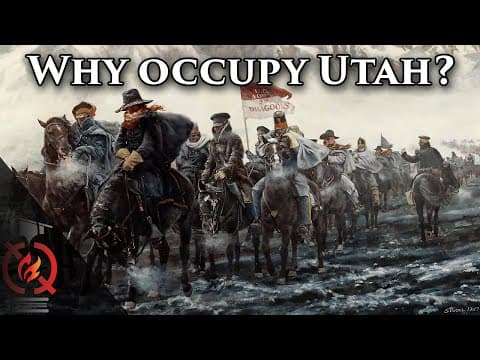
In a remarkable chapter of American history, a third of the U.S. Army marched through Salt Lake City, only to find the streets eerily deserted. Instead of a triumphant welcome, soldiers encountered an almost abandoned town, leading them to encamp 50 miles south to reestablish American control over Utah. This unique military intervention to remove a territorial governor marked a seminal moment in Mormon history. But how did this situation arise?
The story begins with the tragic deaths of Joseph Smith, the founder of the Church of Jesus Christ of Latter-day Saints (LDS), and his brother Hyram at the hands of a mob. This left a power vacuum within the church, with various factions vying for leadership. Brigham Young emerged as the new prophet after a dramatic debate, solidifying his position as the leader of the LDS Church.
Following the turmoil in Illinois, where the Mormons faced increasing persecution, Young directed the faithful to abandon Nauvoo and head west. The goal was to find a territory where they could establish their own community free from external interference. Contrary to popular belief, the decision to settle in the Great Salt Lake was not random; it was a calculated move influenced by the political climate of the time, including the Mexican-American War.
In July 1847, the vanguard of the Mormon Exodus reached the Great Salt Lake, where Young famously declared, "This is the place." He envisioned a society independent of federal oversight, expressing a desire to lead the "armies of Israel" against any who would challenge their authority.
As the Mormons settled in Utah, they quickly established a theocratic governance structure under Young. However, their aspirations for autonomy clashed with federal interests. The Compromise of 1850 created the Utah Territory, with Young appointed as governor. His administration faced scrutiny due to the practice of polygamy and the perception of a seditious attitude towards the federal government.
Polygamy, officially endorsed by Smith in 1843, became a significant point of contention. Young's open practice of polygamy and the rhetoric surrounding it fueled national outrage. Reports from federal officials described the Mormons as a lawless group, further straining relations with Washington.
In 1852, the Utah legislature legalized slavery, which compounded the negative perception of the Mormon community. Young's increasingly racist policies and the violent conflicts with Native American tribes added to the tensions, leading to a reputation of the Mormons as a criminal cult.
As the political landscape shifted, the newly formed Republican Party began to take notice of the situation in Utah. Their platform condemned both polygamy and slavery, which were prevalent in the territory. The national discourse surrounding these issues heightened the scrutiny on Young and his administration.
In 1856, the Mormon Reformation sought to reaffirm the faith of the community amid rising apostasy. Young's call for renewed devotion included a return to strict adherence to polygamy and the introduction of the Word of Wisdom, which prohibited alcohol and tobacco.
President Buchanan, facing political turmoil over slavery, sought to divert attention by addressing the situation in Utah. He appointed Alfred Cummings as the new governor and dispatched 2,500 federal troops to enforce federal authority in the territory. This military presence was perceived as a direct threat to Young's leadership and the autonomy of the Mormon community.
The stage was set for conflict as the federal government sought to reassert control over Utah, while Brigham Young and the Mormons prepared to defend their way of life. The Utah War, characterized by a clash of ideologies and governance, was imminent. This complex interplay of religious fervor, political ambition, and military intervention would shape the future of the region and the legacy of the Mormon community in America.
As we delve deeper into this history, it becomes clear that the occupation of Utah by the U.S. Army was not merely a military action but a significant moment in the ongoing struggle for identity, autonomy, and governance in the American West.



















