
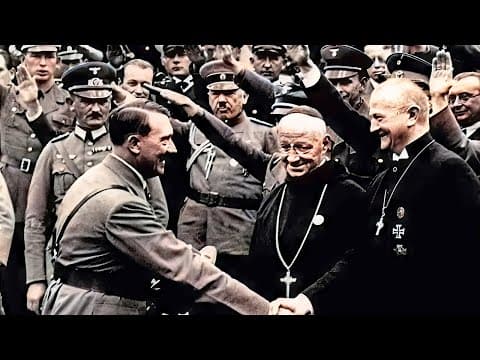
During World War II, the Vatican, led by Popes Pius XI and Pius XII, engaged in a complex and controversial relationship with Nazi Germany. Despite early agreements and some opposition, the Church largely remained silent during the Holocaust, even as it was aware of the atrocities. Post-war, Vatican networks aided Nazi war criminals in escaping justice, raising enduring questions about moral responsibility and complicity.
In 1942, as World War II ravaged the globe with unprecedented violence and destruction, the world awaited moral leadership from its spiritual figures. Pope Pius XII, confined within the Vatican walls in Rome, was the spiritual leader to hundreds of millions of Catholics worldwide. Meanwhile, just 1,000 kilometers away in Poland, Adolf Hitler was orchestrating the systematic extermination of Jews across Europe, a genocide carried out in secret concentration camps.
Despite being one of the most informed men on the planet, Pope Pius XII remained notably silent on the atrocities. This silence, coupled with the Vatican's earlier political dealings with Nazi Germany, has since sparked intense scrutiny and debate.
This article explores the complex and often troubling relationship between the Vatican and the Third Reich, from the early 1930s through the aftermath of the war.
On January 30, 1933, Adolf Hitler was appointed Chancellor of Germany. To consolidate his power and establish a dictatorship, Hitler needed to secure two-thirds of the Reichstag's vote to change the constitution. His key target was the Zentrum, a centrist Catholic political party with significant influence.
Although Nazism and Catholicism were fundamentally opposed in principle, the Vatican saw an opportunity. Pope Pius XI, who led the Church at the time, was primarily concerned with combating communism, which he viewed as a greater threat than Nazism.
To protect the rights of German Catholics, Pope Pius XI sent his Secretary of State, Eugenio Pacelli (later Pope Pius XII), to negotiate with Hitler. The result was the Reichskonkordat, signed on July 20, 1933, an international agreement guaranteeing the Church's autonomy and the freedom to practice Catholicism in Germany.
While the Concordat was a relief for the Vatican, it effectively legitimized Hitler's regime, providing him with the stature of a true head of state. The Zentrum party subsequently voted to grant Hitler full powers, enabling his dictatorship.
Following the Concordat, the German Catholic Church allowed its members to join the Nazi Party, reversing an earlier ban. Dozens of priests became Nazis, and the Church's initial opposition to Nazism softened considerably.
As Nazi anti-Semitic policies intensified, including boycotts and exclusion of Jews from public life, voices within Germany and beyond urged the Vatican to intervene. One notable figure was Edith Stein, a Jewish-born Catholic intellectual and professor who wrote a heartfelt letter to Pope Pius XI in April 1933, pleading for him to condemn the persecution.
Despite receiving her letter, the Pope chose not to act, responding only with a blessing.
By 1937, Pope Pius XI had become disillusioned with Hitler's regime. He issued the encyclical "Mit Brennender Sorge" (With Burning Concern), a secretive and impactful denunciation of Nazism read in German churches. However, Hitler did not publicly react, and the Vatican's opposition remained limited.
In March 1939, Eugenio Pacelli became Pope Pius XII. His approach to Nazi Germany was more cautious and diplomatic than his predecessor's.
Despite the secrecy surrounding the Holocaust, the Vatican was well-informed through its extensive network. In March 1942, the Jewish World Congress sent a detailed report to the Pope, outlining the systematic extermination of Jews, including precise figures. The Polish government-in-exile also confirmed the mass killings.
The Allies publicly condemned the Holocaust in December 1942, yet Pope Pius XII's Christmas address that year barely mentioned the Jews, referring only vaguely to suffering peoples without naming them.
Several factors contributed to this silence:
In October 1943, German forces arrested over 1,200 Jews in Rome's Jewish Ghetto, deporting most to Auschwitz where only 15 survived. Pope Pius XII did not publicly condemn this action, though he did shelter hundreds of Jews in Church properties.
Many Catholics acted independently to save Jews, hiding thousands in convents and monasteries. However, without clear leadership from the Pope, some Catholics aligned with Nazism.
A striking example of Catholic collaboration was Bishop Mayol de Lupe, a French Catholic who openly supported Nazism and served as a military chaplain on the Eastern Front. His anti-communist zeal aligned with Nazi ideology, and he received authorization and blessings from Church authorities, including Cardinal Suhard and Monseigneur Sibilia, close to Pope Pius XII.
This collaboration reflected the Vatican's prioritization of anti-communism over opposition to Nazism, contributing to the Church's ambiguous stance during the war.
After the war, Europe was in chaos, with millions displaced. The Vatican established the Assistant Pontifical Commission to aid refugees. Alois Hudal, a bishop and admirer of Nazism, headed one branch in Rome.
Hudal became notorious for assisting Nazi war criminals in escaping Europe by providing false passports and travel documents, often with Vatican approval.
Franz Stangl, commandant of the Treblinka extermination camp responsible for the deaths of approximately one million people, sought Hudal's help to evade justice. Hudal procured Vatican-backed documents for Stangl, enabling his escape to Syria and later Brazil, where he was eventually captured and imprisoned.
Other notorious Nazis aided by this network included Adolf Eichmann, Josef Mengele, and Klaus Barbie.
A 1947 American Secret Service report identified 22 Vatican members, including Hudal, suspected of facilitating Nazi escapes. While it is unclear if Pope Pius XII was directly aware, experts believe he likely knew but chose not to act publicly.
Pope Pius XII's silence during the Holocaust and the Vatican's post-war assistance to Nazi criminals have left a lasting stain on the Church's history.
He never publicly explained or justified his wartime actions, and it was only in his will, written before his death in 1958, that he expressed regret and sought forgiveness for his shortcomings during his pontificate.
The Vatican's relationship with Nazi Germany was marked by political pragmatism, fear, and moral ambiguity. While the Church sought to protect its interests and combat communism, it failed to take a strong public stand against the horrors of the Holocaust.
Post-war, the Vatican's covert assistance to Nazi war criminals further complicates its legacy. This history serves as a sobering reminder of the challenges and responsibilities faced by spiritual and moral leaders during times of profound human crisis.
Understanding this complex past is essential for reckoning with history and ensuring that silence and complicity are never repeated in the face of injustice.



















