
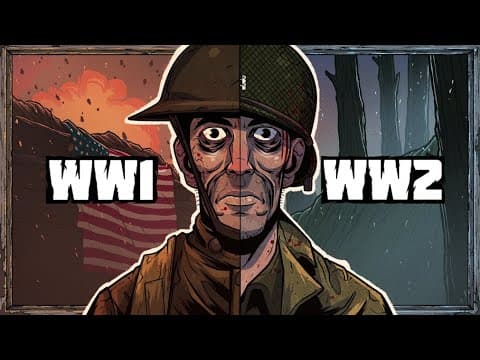
This blog post explores America's involvement in both World Wars, detailing the political, military, and social dynamics that shaped the nation's response to global conflicts. It covers key events, decisions, and the evolution of American military strategy, highlighting the complexities of neutrality, economic interests, and the eventual shift towards active engagement in both wars.
The United States' involvement in the World Wars was marked by a complex interplay of political decisions, military strategies, and social dynamics. This blog post delves into America's perspective during these tumultuous times, exploring how the nation transitioned from isolationism to active engagement in global conflicts.
As World War I erupted in July 1914, the United States initially adopted a stance of neutrality. President Woodrow Wilson urged Americans to remain neutral in thought and deed, prohibiting banks from loaning money to belligerent nations. However, this neutrality was short-lived as economic interests began to sway American policy.
By 1915, the British Empire's financial needs prompted the U.S. to reverse its neutrality stance, allowing loans to the Allies. American trade with Germany plummeted by 99%, leading to tensions that would eventually push the U.S. towards war. Germany's response was a submarine blockade of Britain, which further escalated the situation.
The sinking of the RMS Lusitania in 1915, which resulted in the deaths of 128 Americans, intensified calls for war. Despite this, Wilson sought to maintain peace, but growing anti-German sentiment and incidents of sabotage, such as the Black Tom explosion, fueled the push for military action.
The tipping point came with the interception of the Zimmerman Telegram, in which Germany proposed a military alliance with Mexico against the U.S. This revelation, coupled with ongoing attacks on American ships, led Congress to declare war on Germany on April 6, 1917.
Upon entering the war, the U.S. faced the challenge of rapidly expanding its military. The Selective Service Act initiated conscription, leading to millions of American troops being deployed to Europe. Key battles, such as the Battle of Cantigny and the Meuse-Argonne Offensive, showcased American military capabilities and resolve.
President Wilson played a pivotal role in the post-war negotiations, advocating for his Fourteen Points and the establishment of the League of Nations. However, his vision faced skepticism from European leaders, and the Treaty of Versailles ultimately did not gain U.S. Senate approval, reflecting a return to isolationism.
The interwar period was marked by economic turmoil, culminating in the Great Depression. The Smoot-Hawley Tariff Act of 1930 exacerbated global economic issues, leading to a decline in international trade and further entrenching American isolationism.
As tensions escalated in Europe and Asia during the late 1930s, the U.S. maintained a policy of neutrality, reinforced by the Neutrality Acts. However, President Franklin D. Roosevelt began to shift towards supporting the Allies through initiatives like the Cash and Carry policy and the Lend-Lease Act.
The surprise attack on Pearl Harbor on December 7, 1941, marked a dramatic shift in American policy. The attack galvanized public support for entering the war, leading to a declaration of war against Japan and subsequently against Germany.
The U.S. military strategy evolved significantly during the war. Key operations included the D-Day invasion (Operation Overlord) and the island-hopping campaign in the Pacific. American forces faced fierce resistance but ultimately played a crucial role in the defeat of Axis powers.
The war effort transformed American society, with women entering the workforce in unprecedented numbers and industries shifting to wartime production. The production of Liberty ships and military equipment became a priority, showcasing America's industrial might.
The conclusion of World War II brought about significant changes in global dynamics. The U.S. emerged as a superpower, leading to its involvement in the establishment of the United Nations and a commitment to international cooperation.
Despite the lessons learned from the World Wars, isolationism resurfaced in American politics post-war. The reluctance to engage in foreign conflicts would continue to shape U.S. foreign policy for decades.
America's journey through the World Wars reflects a complex narrative of shifting policies, economic interests, and social changes. The transition from isolationism to active engagement in global conflicts reshaped the nation and its role on the world stage, leaving a lasting legacy that continues to influence contemporary American foreign policy.



















