
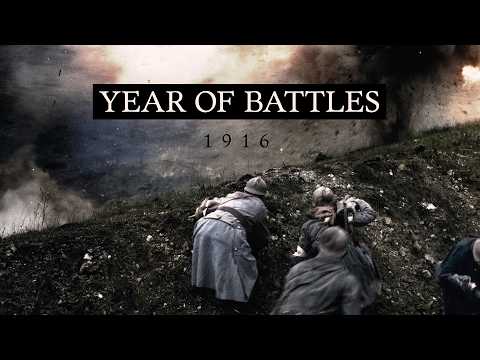
1916 marked a pivotal year in the First World War, characterized by brutal battles such as Verdun and the Somme, where both the Allies and Central Powers faced staggering casualties without achieving decisive victories. The year highlighted the horrors of trench warfare, the strategic miscalculations of military leaders, and the profound impact on soldiers and civilians alike.
1916 was a year of unprecedented bloodshed and strategic stalemate in the First World War. As the conflict entered its third year, millions had already perished, yet neither the Allies nor the Central Powers had achieved their war aims. This blog post delves into the significant battles of 1916, the strategies employed, and the human cost of this brutal conflict.
At the end of 1915, the Central Powers had made significant gains, including the defeat of the Russian army and the containment of Italy. However, Austria-Hungary faced crippling losses, and the Allies still held better long-term prospects for victory. Allied planners convened in December 1915 to strategize massive offensives for the summer of 1916 across all fronts.
The Central Powers, particularly Germany, decided to strike first, targeting the French at Verdun, a heavily fortified area. Chief of Staff Erich von Falkenhayn believed that a breakthrough was essential to inflict unsustainable losses on France. Historians debate whether Falkenhayn's original plan was to bleed France white or to achieve a quick victory by capturing the city itself.
On February 21, 1916, the Germans launched Operation Judgment, employing overwhelming artillery fire and innovative infiltration tactics. Despite initial successes, the French managed to regroup and reinforce their defenses. The battle quickly devolved into a war of attrition, with both sides suffering heavy casualties.
Conditions at Verdun were horrific. Soldiers faced unimaginable suffering, with corpses littering the battlefield and medical services overwhelmed. The French High Command's decision to hold Verdun at all costs became a symbol of national resolve, while German expectations of a quick victory faded as the battle dragged on.
By late May, the French had stabilized their defenses, and the Germans, despite initial gains, found themselves in a precarious position. The introduction of the Noria rotation system by the French allowed for better management of troop fatigue, while the Germans struggled with morale as their initial plans unraveled.
In July 1916, the Allies launched the Battle of the Somme, intending to relieve pressure on Verdun and achieve a breakthrough. The offensive began with a massive artillery bombardment, but the execution was flawed. Many shells failed to detonate, and the German defenses remained largely intact.
On July 1, 1916, British troops went over the top, facing devastating machine-gun fire. The day became the bloodiest in British military history, with 57,000 casualties. The French, however, achieved some success in their sector, capturing German positions.
The battle evolved into a series of smaller attacks, with both sides suffering heavy losses. The British learned valuable lessons about coordination and tactics, while the Germans faced increasing pressure from multiple fronts, including the Brusilov Offensive in the East.
In June 1916, Russian General Alexei Brusilov launched a successful offensive against the Austro-Hungarian forces, employing innovative tactics that contrasted sharply with the static warfare seen in the West. The offensive aimed to relieve pressure on the Allies and exploit weaknesses in the Austro-Hungarian lines.
Brusilov's forces achieved significant breakthroughs, capturing tens of thousands of prisoners and threatening the stability of the Austro-Hungarian Empire. However, the offensive lacked a clear strategic goal, and as the summer wore on, the momentum began to wane.
By the end of 1916, the war had claimed staggering casualties: approximately 2.5 million for Germany, 3.5 million for Austria-Hungary, 1 million for Britain, 3.3 million for France, and 5.3 million for Russia. The Central Powers had survived a severe crisis, but the Allies were no closer to victory.
The battles of Verdun and the Somme became symbols of the war's futility and the suffering endured by soldiers. They highlighted the strategic miscalculations of military leaders and the devastating impact of industrial warfare on human life.
As 1916 came to a close, both sides remained entrenched in a brutal stalemate, with no end in sight. The lessons learned from the year would shape military strategies and the course of the war in the years to come, as the world grappled with the horrors of total war.



















