
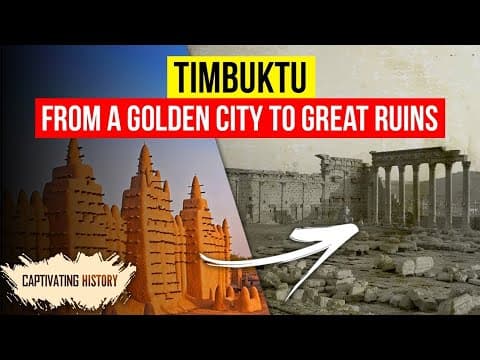
Timbuktu, once a thriving center of trade, culture, and Islamic scholarship in West Africa, has a rich history marked by its founding by the Tuareg people, its rise under the Mali Empire, and its eventual decline due to external invasions and internal strife. This blog post explores the city's transformation from a golden metropolis to its current state of ruin, highlighting key historical events and figures that shaped its legacy.
The history of Timbuktu, a city located in modern-day Mali, is a subject of much debate among historians. The exact date of its founding remains uncertain, with suggestions ranging from the 5th to the 12th century. This blog post delves into the fascinating journey of Timbuktu, exploring its rise as a vibrant center of trade and culture, its significance in the Islamic world, and its eventual decline into ruins.
Timbuktu was established by the Tuareg people, who were nomadic tribes known for their trade routes across the Sahara Desert. The city developed into an ancient metropolis, boasting advanced schools, libraries, and mosques, akin to an ancient New York City. Despite its historical significance, the early years of Timbuktu remain shrouded in mystery. Recent archaeological findings, environmental studies, and genetic research have led to various hypotheses about its origins.
Historians generally agree that Timbuktu was founded between the 5th and 12th centuries, with some attributing its name to a Tuareg woman. The name itself has several interpretations, including "place covered by small dunes" and "the well of Bouctou."
The Tuareg people, believed to be descendants of the ancient Berbers, played a crucial role in the establishment of Timbuktu. The Berbers, indigenous to northwestern Africa, have a history that dates back over 100,000 years, with evidence of their existence found in ancient rock art. The Tuaregs developed a distinct culture and began to spread throughout the Sahara, eventually reaching the area where Timbuktu is located.
By the 13th century, Timbuktu emerged as a vital trading post, benefiting from its strategic location that allowed easy access from northern, western, and southern Africa. The city became a melting pot of cultures and ideologies, particularly Islam. Although the earliest evidence of Islamic influence dates to the 13th century, it is likely that the spread of Islamic teachings began earlier.
The rise of the Mali Empire in the early 13th century significantly impacted Timbuktu's development. Under the rule of King Sumanguru, the empire expanded, leading to the eventual rise of Sundiata Keita, who unified several kingdoms and established the Mali Empire's capital at Niani.
During the reign of Mansa Musa in the 14th century, Timbuktu reached its zenith. Musa's pilgrimage to Mecca in 1324 brought global attention to the Mali Empire, showcasing its wealth and cultural significance. Under his leadership, Timbuktu became a center for Islamic scholarship, attracting scholars from across Africa, the Middle East, and beyond.
The establishment of the University of Sankoré, which at its peak enrolled over 25,000 students, and the construction of the Djinguereber Mosque in 1327 solidified Timbuktu's status as a hub of learning. The city housed the best library in Africa, containing invaluable Islamic texts and knowledge across various disciplines.
Following Mansa Musa's reign, the Mali Empire faced numerous challenges. His successor, Mansa Suleyman, struggled to maintain stability amid internal strife and external threats. The emergence of the Mossi Empire and the Songhai people, who reclaimed their territory in the 15th century, further destabilized the region.
Despite the Tuareg people's attempts to reclaim their land through rebellions, they ultimately lost control of Timbuktu to the Songhai Empire. The city continued to thrive as a center of trade and scholarship until the late 16th century when it fell under Moroccan control, leading to its decline.
In the 19th century, Timbuktu became a focal point for European interest, culminating in its conquest by France in 1894. Although some efforts were made to restore the city, it remained in a state of decay, resembling ancient ruins rather than a vibrant urban center.
After World War II, the newly-formed Republic of Mali took control of Timbuktu, but the Tuareg people faced ongoing political instability and conflict. Armed groups and political rebellions have plagued the city, leading to the destruction of its historical sites and cultural heritage.
Today, Timbuktu stands as a testament to its glorious past, with many of its sacred items being exported to preserve them from destruction. The city's rich history, marked by its rise as a center of trade and scholarship, serves as a reminder of the cultural and intellectual achievements of the Mali Empire. As we reflect on Timbuktu's journey from a golden city to great ruins, we are left with the hope that its legacy will endure and inspire future generations.



















