
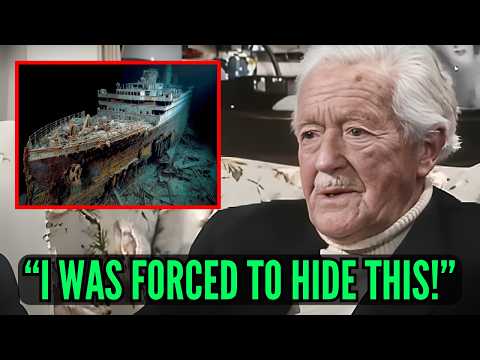
A Titanic survivor reveals chilling details about the sinking, suggesting it may not have been an iceberg but rather a series of explosions, a fire, or even a conspiracy involving insurance fraud. Theories abound, from a ship switch to a mummy's curse, and the influence of J.P. Morgan in the establishment of the Federal Reserve. This blog explores these accounts and theories, questioning the true cause of the Titanic disaster.
Over a century later, the accounts of Titanic survivors continue to send chills down our spines. While most of us accept that an iceberg ended the voyage, some survivors have suggested something more sinister. Could the iceberg be a convenient cover for a far darker truth? In this post, we will dive deep into survivor accounts, conspiracy theories, and long-buried secrets behind the Titanic’s tragic end.
More than sixty years after that frigid night in 1912, Titanic survivor Frank Prentice could barely hold back tears as he recounted his experience. As the assistant purser, he was trained to remain calm and organized under pressure, but nothing prepared him for the horror he lived through.
Prentice recalled in a 1979 BBC documentary, "There was no impact as such. It was just like jamming your brakes on the car, and that was that, she stopped." For decades, the world believed the Titanic struck an iceberg with devastating force. However, for those on board, like Prentice, the sensation was startlingly uneventful. There was no violent jolt, no screeching metal, just a sudden, eerie stop.
Prentice was in his cabin when it happened. The porthole was open, and he looked out to see a clear sky and stars sparkling above a calm sea. He saw nothing unusual, no panic, and no visible damage. Yet, the ship, the “unsinkable” marvel of engineering, had stopped cold in the middle of the Atlantic. Something was wrong, but no one knew what.
Soon, orders were given for Prentice to go below deck and retrieve food supplies for the lifeboats. By the time he returned, the Titanic was listing dangerously, and chaos was escalating. He could no longer reach the lifeboats. That’s when he heard it: four distinct reports, dull, echoing booms from deep within the ship. Not the kind of sound you’d expect from scraping ice. These were explosions.
Prentice, like many others, was thrown into the freezing water as the ship split in two. He hit the ocean with a “terrific crack,” saved only by a lifebelt and, as he put it, “the grace of God.” Floating among bodies, watching the stern rise high before plunging beneath the sea, he felt certain he was going to die. But somehow, he survived, though not without scars. He later said, "You lie in bed at night and the whole thing comes round again."
Multiple survivors gave eerily similar testimonies to the U.S. Senate inquiry, speaking of no major collision but rather subtle vibrations, quiet panic, and strange internal sounds. What kind of iceberg causes explosions within a ship? The official explanation pointed to ruptured steam pipes or pressurized boilers, but no one could confirm it with certainty. This lack of external drama has fueled conspiracy theories for decades.
One of the most compelling theories in maritime history suggests that the ship that sank in 1912 wasn’t actually the Titanic. This theory, known as the Olympic switch theory, posits that the Titanic’s sister ship, the RMS Olympic, was disguised as the Titanic and deliberately sunk in a scheme to commit insurance fraud.
To understand why this theory gained traction, we must revisit the circumstances leading to the Titanic’s fateful voyage. The RMS Olympic was launched a year before the Titanic and was nearly identical in design. However, in September 1911, the Olympic was involved in a major accident with the British warship HMS Hawke, which severely damaged her hull.
The repairs were extensive and costly, and the White Star Line’s insurers refused to pay, claiming the Olympic was at fault. This left the ship’s owners with a financial disaster and a motive to pull off the greatest maritime swap in history. The theory claims that the Olympic, no longer financially viable and possibly still structurally unsound, was hastily patched up and secretly renamed as the Titanic. Meanwhile, the real Titanic would later sail under the Olympic name.
Proponents of this theory point to several pieces of evidence, including the number of portholes on the ship. Original plans show the Titanic with 14 portholes on one side of the forward C deck, while the Olympic had 16. When the Titanic set sail, photos showed it had 16, just like the Olympic. Coincidence? Some don’t think so.
Critics of the theory argue that the logistics of pulling off a full-scale ship swap in less than two weeks are implausible. The two ships, while nearly identical, had different floor plans, mechanical systems, and serial numbers. Swapping them would have required enormous labor and secrecy, with no credible whistleblower coming forward over the last century.
Among the many passengers aboard the Titanic was William Stead, a respected British journalist with a fascination for the supernatural. Stead brought with him a chilling story of an ancient Egyptian mummy said to carry a deadly curse. He believed the artifact was aboard the ship and regaled fellow first-class passengers with tales of its doom.
According to Stead, the artifact was the coffin lid of a high priestess, rumored to bring death to anyone who handled it. In the years before the Titanic’s voyage, a series of unexplained mishaps occurred at the British Museum, where the mummy’s lid supposedly rested. Guards quit their jobs, curators fell ill, and one journalist died mysteriously after handling it.
After the Titanic sank, the media seized on Stead’s eerie tale, and headlines filled with talk of a “mummy’s curse.” The public, reeling from the tragedy, grasped at any explanation, no matter how improbable. However, the truth is far less dramatic; the supposed mummy never left the British Museum and was never placed on the Titanic.
When the Titanic sank, it marked more than just a maritime tragedy. For some, it became the centerpiece of a dark theory suggesting the ship’s destruction was intentional, designed to clear the path for the establishment of the Federal Reserve. At the heart of this theory stood J.P. Morgan, a towering figure in American finance.
Morgan had controlling interest in the White Star Line, which owned the Titanic. He had booked a luxurious suite for the maiden voyage but canceled at the last moment, claiming poor health. This sudden change raised suspicions, especially since three of Morgan's chief opponents against the creation of a centralized American banking system were aboard the Titanic and perished in the disaster.
Critics of this theory argue that there’s no definitive proof linking Morgan to a plot, and his change of plans could have been a personal choice. However, the timing of the Federal Reserve Act, passed just over a year after the disaster, has fueled speculation.
For over a century, the story has remained the same: the Titanic struck an iceberg. However, Captain L.M. Collins, a veteran ice expert, challenged this narrative, suggesting the ship scraped along a field of pack ice instead. This theory posits that the Titanic didn’t collide with a towering iceberg but rather with a vast, flat, and nearly invisible expanse of hardened Arctic ice.
Collins noted inconsistencies in survivor reports regarding the iceberg’s size, suggesting that super refraction, a trick of light in extreme cold, distorted perceptions. He argued that the Titanic’s hull was breached in several places by pack ice, explaining why many survivors reported hearing grinding noises instead of a loud crash.
Beneath the polished promenades of the Titanic, a hidden danger may have been smoldering long before the ship ever saw an iceberg. Reports suggest a fire had been burning in one of the coal bunkers for several days before the Titanic set sail. This fire could have compromised the steel in the hull, weakening it just enough to turn a glancing blow into a fatal wound.
Coal bunker fires were not uncommon, but this particular blaze may have reached temperatures that weakened the hull. Ironically, the frantic effort to contain the fire may have accelerated the ship’s speed, possibly contributing to the disaster.
The Titanic’s legacy is more than steel and rivets; it’s emotion, mystery, and memory. Was it really an iceberg that sealed its fate? Or was it sabotage, fire, mistaken identity, or something worse? The theories surrounding the Titanic continue to captivate our imagination, leaving us to ponder the true cause of this maritime tragedy.



















