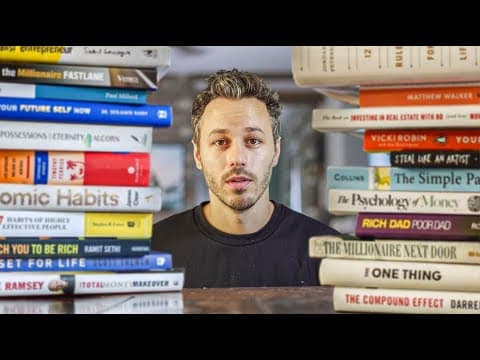
After reading over 40 books on money and personal finance, I share my top 20 recommendations that have significantly impacted my journey to financial independence. These books cover essential concepts like frugal living, investing, and the mindset needed for wealth creation.
In my journey towards financial independence, I have read over 40 books on money and personal finance. The insights gained from these readings have been transformative, taking me from zero to almost financially independent. Here, I share my top 20 finance books that I recommend to anyone looking to improve their financial literacy and achieve wealth.
This book is a foundational read for anyone interested in financial independence and early retirement. Trench covers essential topics such as frugal living and house hacking. One of the key ideas is building a financial runway—creating enough accessible wealth to survive without work for extended periods. This concept aligns with the FIRE (Financial Independence, Retire Early) movement, emphasizing the importance of spending less and investing wisely.
Despite some outdated information, this book has the potential to transform your life. Ferriss introduces the concept of "dreamlining," where you outline your goals and calculate the costs associated with achieving them. This exercise helps you identify how to earn the necessary income to fund your dreams. A memorable quote from the book is, "Less is not laziness," which resonates with minimalists.
Hardy emphasizes that significant life changes come from daily habits. The book illustrates how small, consistent actions lead to extraordinary results over time. For instance, investing early can dramatically increase your wealth due to compound interest. A dollar invested at 20 can grow to $88 by retirement, while waiting until 30 reduces that amount to $33.
Part of the Rich Dad Poor Dad series, this book introduces the four quadrants of income: Employee, Self-Employed, Business Owner, and Investor. To build wealth, Kiyosaki suggests moving from the left side (Employee and Self-Employed) to the right side (Business Owner and Investor), where your money works for you.
For those interested in stock market investing, Collins provides a straightforward approach: spend less than you earn, avoid debt, and invest in low-cost index funds. He advocates for a 50% savings rate and highlights the historical growth of the stock market, making a compelling case for long-term investing.
This book is a must-read for aspiring real estate investors. Turner offers practical strategies for acquiring properties with little to no money, focusing on leveraging other people's resources. While it can be risky, the potential rewards are significant.
This book explores the relationship between money and life energy. It encourages readers to reconsider their spending habits and view money as a trade-off for their time and energy. This perspective can lead to a more mindful approach to finances and a desire for minimalism.
A classic in personal finance literature, this book contrasts the financial philosophies of Kiyosaki's two father figures. It introduces concepts like assets versus liabilities and the importance of financial education. While it may not offer new insights for seasoned readers, it serves as a great starting point for beginners.
Housel's book delves into the emotional aspects of money management. He argues that while money cannot buy happiness, it can provide freedom. The book emphasizes that simple financial advice, such as investing in low-cost index funds, often yields the best results.
Fisker advocates for extreme frugality as a means to achieve early retirement. The book challenges readers to adopt unconventional habits that most people find difficult to understand or implement. It’s a thought-provoking read for those willing to make significant lifestyle changes.
DeMarco encourages readers to take control of their financial destinies. He emphasizes that you are the driver of your life and finances, and your success is determined by your actions and mindset.
While not strictly a finance book, Pressfield's work focuses on professionalism and productivity. He discusses the mindset shift from amateur to professional, which can significantly impact your financial situation and overall success.
This classic study of millionaires reveals that many wealthy individuals live below their means. They prioritize hard work, perseverance, and self-discipline over flashy lifestyles. The book provides valuable insights into the habits that lead to wealth accumulation.
Lavingia’s book is geared towards entrepreneurs, emphasizing profitability over rapid growth. He advocates for a sustainable approach to business that prioritizes long-term success and financial health.
Sethi offers a practical guide to managing finances without sacrificing enjoyment. He focuses on achieving financial goals by making smart choices rather than cutting out small pleasures. This book is ideal for those seeking a balanced approach to wealth building.
Covey’s principles extend beyond finance but are crucial for personal accountability and decision-making. His quote about taking responsibility for your choices can inspire readers to take control of their financial futures.
These 20 books have shaped my understanding of money and finance, providing valuable lessons on wealth creation, frugality, and the mindset necessary for financial independence. Whether you are just starting your financial journey or looking to deepen your knowledge, these recommendations can guide you toward achieving your financial goals.
Feel free to explore these titles and discover the insights that resonate with you on your path to financial independence.