
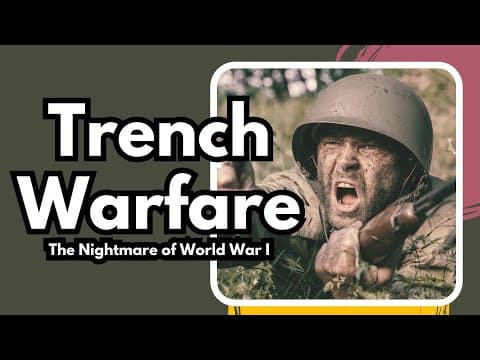
Trench Warfare: The Nightmare of World War I and Its Modern Echoes
This blog post explores the history and impact of trench warfare during World War I, detailing its origins, the human toll, and modern parallels in conflicts like the Ukraine war, highlighting the lessons learned and the ongoing challenges of warfare.
Trench warfare during World War I became synonymous with suffering and devastation, transforming battlefields into stagnant, nightmarish landscapes. Soldiers faced relentless artillery, machine gun fire, disease, and despair while enduring months in mud-filled, rat-infested trenches. Historian Paul Fussell poignantly described the Western Front as not just a battlefield but a graveyard of humanity's innocence and hope.
Part One: The Origins of Trench Warfare
By 1915, the Western Front had evolved into a static battlefield characterized by miles of parallel trenches stretching from the North Sea to the Swiss border. Soldiers lived in these trenches for months, facing the horrors of No Man's Land—the deadly zone between opposing trenches filled with barbed wire and shell craters. Life in the trenches was miserable; mud, rats, and constant shelling made survival brutal. At any given time, over 2.5 million soldiers inhabited these trenches, with trench foot and dysentery plaguing more than 20% of them.
World War I introduced new weapons that made trench warfare even more lethal. Machine guns decimated waves of attackers, while poison gas blinded and choked soldiers. Armored tanks, first used in 1916, attempted to break the stalemates, and submarines dominated the seas with torpedoes. However, these advancements only deepened the human cost without accelerating the war's pace.
Poison gas was first deployed in the Battle of Ypres on April 22, 1915, with chlorine gas used against French and Canadian forces, resulting in between 6,000 to 7,000 casualties.
Part Two: The Human Toll
Battles like Verdun and the Somme showcased the horrifying scale of trench warfare. At the Battle of Verdun, 300,000 men died for a mere four-mile gain. The Battle of the Somme was equally devastating, with British forces losing 20,000 soldiers in a single day; by the battle's end, half a million men on each side were casualties. One soldier described the experience as living hell, with trenches filled with the dead, unbreathable air, and constant fear.
Statistics from these battles highlight the grim reality: in the Battle of Verdun, France and Germany lost over 700,000 men combined. The first day of the Somme saw 57,000 British casualties, marking the bloodiest single day in British military history.
Part Three: Modern Parallels in the Ukraine War
A century later, trench warfare has returned, this time in Ukraine. The conflict mirrors World War I in its use of static positions and fortified lines. Ukrainian and Russian soldiers face modern challenges such as drones, precision artillery, and advanced surveillance. Yet, the fundamentals of trench warfare—endurance, attrition, and horror—remain unchanged.
Life in the trenches today is grueling, with soldiers enduring freezing conditions, shortages of supplies, and relentless attacks. A news article from Reuters reported on May 29, 2024, that winter temperatures in the trenches fell as low as -26 degrees Celsius, while warmer days turned the ground into slushy mud. Russian drones hovered overhead, dropping grenades on soldiers below.



















