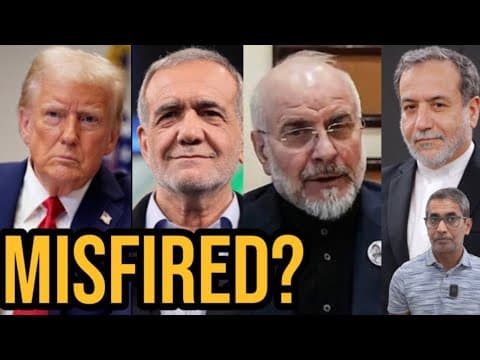
Recent developments reveal Iran activating its air defense system in Tehran, likely testing new Chinese-supplied weaponry. Meanwhile, Trump's administration faces internal turmoil, including high-profile military dismissals. Iran's leadership shows unprecedented unity in response to Trump's provocations. Additionally, Iran's innovative use of AI-generated media challenges US narratives, highlighting the complex dynamics of the ongoing conflict.
The fragile ceasefire between Iran and the United States under Donald Trump's administration is experiencing unexpected developments daily. Recent reports indicate that the Islamic Revolutionary Guard Corps (IRGC) activated its air defense system in Tehran, a significant move considering China's recent role in strengthening Iran's military capabilities. Concurrently, Trump's actions appear to have unified the Iranian leadership in an unprecedented manner, even as his own administration faces internal crises, including the dismissal of the head of the US Navy amid the ongoing conflict.
Moments ago, Iran's semi-government news agency reported the activation of the IRGC's air defense system in Tehran. Al Jazeera broadcasted live coverage, noting that air defense fire was observed over the Iranian capital within the last hour. Iranian media reported engagements with "hostile targets" over Tehran, though no official confirmation of attacks was made.
Eyewitnesses described seeing air defenses activated near prominent landmarks, with no explosions or bangs heard, suggesting the event might have been a military maneuver or drill rather than an active engagement.
This activation aligns with earlier reports from April 11th, when the US accused China of shipping sophisticated weapons to Iran to enhance its air defense system. The US administration's concern was so intense that President Trump claimed to have written to China, urging them not to send weapons to Iran, accompanied by threats of consequences.
Given this context, many speculate that the recent activation was a test of the new Chinese-supplied air defense systems. Iran has been aggressively improving its military preparedness during the ceasefire, including unveiling an underwater missile city and deploying ballistic missiles if conflict resumes.
In a surprise attack on the state of Hormuz, Iranian gunboats and armed IRGC personnel took control of two oil tankers and damaged a third. The Iranian military released a video of this operation, showcasing their asymmetric warfare capabilities. Iran has since collected toll payments from the state of Hormuz in Chinese currency, bypassing the US dollar.
This clever military maneuver has puzzled American forces, contradicting President Trump's claims of having destroyed the Iranian Navy.
While Iran strengthens its military posture, the US military is experiencing unprecedented internal instability. The Trump administration has dismissed over a dozen military generals, including the head of the US Navy, John Felon, at a critical time when naval operations are vital in the conflict with Iran.
Additionally, a top American nuclear scientist, Andrew Hug, was caught in a honey trap operation revealing sensitive information about US nerve agents and nuclear arsenal details. He was promptly dismissed by the administration.
The leaked information included alarming details about chemical weapons safety lapses and the US military's nuclear defense mechanisms, as well as allegations of corruption involving Ukrainian officials misusing US aid funds.
President Trump tweeted about supposed infighting within the Iranian leadership, claiming confusion over who leads Iran and describing a divide between hardliners and moderates. He asserted US control over the state of Hormuz, stating no ship could enter or leave without US Navy approval.
Contrary to Trump's assertions, Iranian leaders responded with unified statements emphasizing national unity and obedience to the supreme leader. President Masoud Pzeskan, Iranian Parliament Speaker Muhammad Bakar Khalibah, and Foreign Minister Say Basarakshi all stressed that there are no factions within Iran, only a united revolutionary front ready to make aggressors regret their actions.
On the same day, Israeli forces killed journalist Amal Khalil in Lebanon and continued attacks in North Gaza, violating the ceasefire over 2,500 times since last year. These actions have intensified regional tensions, with Iran's asymmetric warfare tactics being a significant challenge to both Trump and Israeli interests.
Iran has effectively utilized artificial intelligence and social media to embarrass its adversaries. A pro-Iran group named Explosive Media has produced a series of AI-generated Lego-style animations depicting the conflict, mocking the US war effort and President Trump.
These videos have garnered hundreds of millions of views worldwide and have been shared by official Iranian government accounts and pro-Iran social media users. Despite their viral success, YouTube banned Explosive Media's official account, citing violations of spam and deceptive practices policies. This move sparked outrage from the Iranian Ministry of Foreign Affairs, which accused the US of suppressing truth and shielding false narratives.
Explosive Media, consisting of fewer than ten people, admitted that the Iranian government is one of their clients, although they claim independence. Their videos, while not always factually accurate, serve as a powerful tool in Iran's information warfare, paralleling similar tactics used by Donald Trump.
The ongoing conflict between Iran and the US under Trump's administration is marked by military posturing, internal political turmoil, and innovative information warfare. Iran's activation of its air defense system, bolstered by Chinese support, and its unified leadership response to Trump's provocations highlight a complex and evolving situation. Meanwhile, the US faces challenges both on the battlefield and within its own ranks, as Iran leverages technology and asymmetric tactics to maintain resilience.
The use of AI-generated media by Iran represents a new frontier in modern conflict, demonstrating the power of narrative and perception in international relations. As the situation develops, the world watches closely, aware that the dynamics between these nations have far-reaching implications for regional and global stability.
Thank you for reading this comprehensive analysis of the current Iran-US conflict dynamics. Stay informed and engaged with independent journalism to understand the complexities of global affairs.