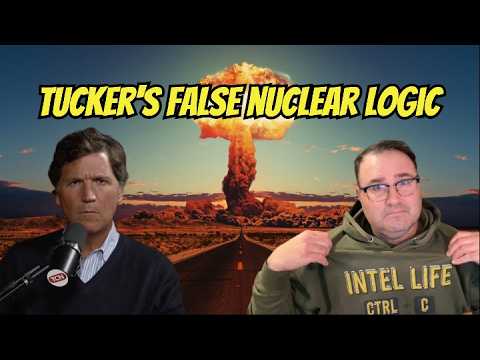
This article critically examines Tucker Carlson's recent interview with Russian political scientist Sergey Caranov, highlighting Carlson's use of misinformation, logical fallacies, conspiracy theories, and anti-Semitic undertones. It discusses Carlson's flawed arguments on topics such as NATO, Ukraine, Iran, and nuclear threats, emphasizing the importance of fact-based discourse and the dangers of propaganda in media.
Recently, entertainer Tucker Carlson released a video featuring an interview with Russian political scientist Sergey Caranov. This video marks the sixth instance where Carlson's claims have been critically debunked for spreading misinformation. Carlson presents his interpretations as gospel truths, often pandering to Russian apologists and elevating questionable figures like Caranov without critical scrutiny.
Sergey Caranov is a Russian political scientist known for advocating "assertive deterrence," which includes the use of limited nuclear strikes to secure national interests. He views restraint as objectionable, even immoral. Carlson's interview with Caranov avoids critical questioning, allowing Caranov to promote dangerous ideas unchecked.
Carlson's video is riddled with logical fallacies, half-truths, conspiracy theories, and personal attacks. His approach lacks transparency and fails to cite verifiable sources, which undermines responsible discourse.
Carlson commits the ad hominem fallacy by attacking individuals personally rather than addressing their arguments or policies. For example, he targets George Soros, describing him as a financier who has "sown chaos and hatred" without engaging with the substance of Soros's actions or policies. This tactic distracts audiences and feeds into conspiracy theories about elites.
Moreover, Carlson's attacks on Soros carry anti-Semitic undertones, echoing harmful stereotypes and narratives reminiscent of the "Protocols of the Elders of Zion."
Carlson builds arguments on false premises, such as suggesting the United States might take Greenland by military force. Greenland is a Danish protectorate, and Denmark has not transferred sovereignty, making such claims baseless.
He also makes hasty generalizations, like asserting that everyone in Ukrainian leadership is connected to George Soros. There is insufficient evidence to support such sweeping claims, which amount to conspiracy theories.
Carlson implies a sinister Western plot to control Ukraine, citing Soros's influence. However, historical facts contradict this narrative. For instance, in 2001, Vladimir Putin personally requested to join NATO, which was declined by the Bush administration. Carlson's suggestion that NATO rejection caused the Russia-Ukraine conflict is a false cause fallacy. The conflict stems from Putin's aggressive actions and ambitions, not NATO's decisions.
Carlson employs scare tactics by presenting extreme and improbable disaster scenarios, such as Iran becoming a failed state like Libya or Israel suffering devastating attacks. While these concerns are not entirely unfounded, Carlson exaggerates and simplifies complex geopolitical realities, ignoring regional dynamics and cultural distinctions, such as the difference between Persian and Arab societies.
Carlson leans heavily on Sergey Caranov's perceived authority to support his claims about Russia's intentions, including the use of nuclear weapons against Europe. However, Caranov is not an official spokesperson for the Russian government and lacks direct links to key Russian security bodies. This reliance on questionable authority weakens Carlson's arguments.
Throughout the video, Carlson stacks various conspiracy theories—such as CIA involvement in sabotage, assassination attempts on Putin, and secret weapons labs in Ukraine—without providing credible evidence or logical connections. This creates a misleading narrative that serves to confuse and manipulate viewers.
Carlson claims Russia is actively considering nuclear strikes against the UK and Germany. While Russia's nuclear posture has become more aggressive, the reality is more nuanced. Russia depends on Europe economically and politically, and nuclear escalation would likely provoke severe retaliation, making such actions strategically unwise.
Carlson occasionally references real events, such as political changes in Moldova, but mixes these with unsupported leaps and conspiracy theories. This blending of fact and fiction makes it difficult for audiences to discern truth from misinformation.
Celebrities like Tucker Carlson complicate efforts to defend national interests by spreading misinformation and conspiracy theories. His show functions as an information weapon that advances Russian agendas by influencing public opinion and political discourse in the United States.
In an era of complex geopolitical conflicts, it is crucial to approach information critically, verify sources, and avoid falling prey to logical fallacies and conspiracy theories. Tools like Ground News, which aggregate news from multiple perspectives and highlight media biases, can help audiences gain a more balanced understanding.
Tucker Carlson's recent interview with Sergey Caranov exemplifies a dangerous pattern of misinformation, logical fallacies, and fearmongering. By elevating questionable figures, relying on conspiracy theories, and ignoring inconvenient facts, Carlson undermines informed public discourse. Responsible media consumption and critical thinking are essential to counteract such disinformation and to understand the true complexities of international relations and conflicts.
This analysis underscores the need for fact-based discussions and the rejection of personal attacks and conspiracy theories in political commentary. Only through transparency, source verification, and logical reasoning can audiences navigate the challenging landscape of modern media and geopolitics.