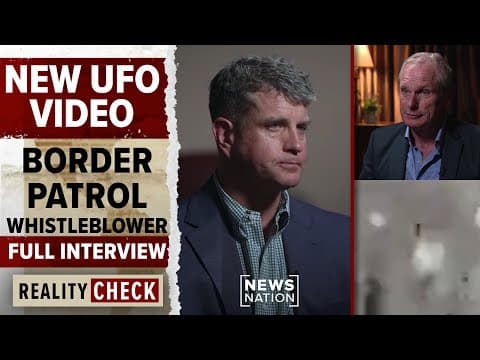
Bob Thompson, a retired Border Patrol agent, shares his experiences with unidentified aerial phenomena (UAP) observed during his service along the Arizona-Mexico border, raising concerns about national security and the need for proper reporting mechanisms.
In a recent episode of Reality Check, host Ross Kulart interviews Bob Thompson, a retired Army veteran and former Border Patrol agent, who reveals his experiences with unidentified aerial phenomena (UAP) observed during his 14 years of service with the U.S. Customs and Border Protection (CBP). This blog post summarizes Thompson's insights and the implications of his findings on national security.
Bob Thompson served in the Tucson sector of the Border Patrol, focusing on counterterrorism and drug interdiction. His last assignment involved the Arizona Air Coordination Center, where he monitored airspace along the U.S.-Mexico border. During his tenure, he encountered evidence of anomalous objects tracked by surveillance aircraft, which he refers to as the "rubber ducky."
Thompson became alarmed by the lack of concern from his superiors regarding these unexplained objects. He believed that unidentified objects in U.S. airspace, especially near the border, should be treated as a national security issue. He documented his findings in a report and sought permission to share his discoveries, which is rare for someone with his background.
Thompson has had personal sightings of various anomalous objects, including orbs and cigar-shaped crafts. He noted that many of his colleagues, at least a hundred agents, reported similar experiences. These sightings included:
Despite the extraordinary nature of these sightings, Thompson noted that many agents did not consider them a safety concern, as they did not appear hostile.
Thompson highlighted a significant issue within the Border Patrol: there were no formal reporting requirements for UAP sightings unless they were directly related to smuggling. This lack of protocol meant that many sightings went unreported, and agents were hesitant to discuss their experiences due to the stigma surrounding the topic.
Interestingly, Thompson learned that the U.S. Air Force was also observing strange objects in the same training areas. Reports indicated that Air Force pilots had near-misses with unidentified objects, raising concerns about flight safety. However, there was little communication between the Border Patrol and the Air Force regarding these sightings.
One of the most notable pieces of evidence Thompson encountered was the rubber ducky video, which was analyzed by the Scientific Coalition for UAP Studies (SCU). The SCU concluded that the object in the video was anomalous, ruling out conventional explanations such as drones or balloons. The video showed an object moving in a circular pattern, suggesting it was under intelligent control.
Thompson expressed concern that the Department of Homeland Security (DHS) was not adequately investigating UAP sightings, despite the potential implications for national security. He believed that the DHS could play a crucial role in monitoring and understanding these phenomena, especially given their proximity to sensitive areas like military training ranges and nuclear facilities.
Bob Thompson's revelations shed light on a significant gap in the reporting and investigation of UAP sightings within the Border Patrol and the broader implications for national security. His experiences highlight the need for a more structured approach to documenting and addressing these phenomena, ensuring that safety concerns are taken seriously and that communication between agencies is improved. As the conversation around UAPs continues to evolve, it is crucial for government agencies to prioritize transparency and collaboration in addressing these unexplained occurrences.