This blog post explores how long-term capital gains can affect your tax bracket, using examples to illustrate the interplay between ordinary income and capital gains. It highlights the tax rates for 2023, explains how capital gains are taxed, and discusses potential tax traps for retirees.
When it comes to taxes, many individuals are often confused about how different types of income are taxed, particularly when it comes to capital gains. This blog post will clarify how long-term capital gains can impact your overall tax situation, especially regarding whether they can push your ordinary income into a higher tax bracket.
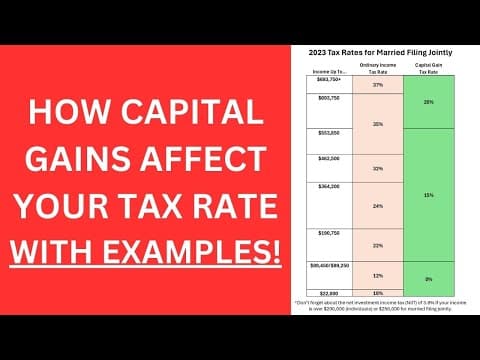
In the United States, there is a significant difference between the tax rates applied to ordinary income and those applied to long-term capital gains. For the tax year 2023, the tax brackets for ordinary income and long-term capital gains are structured differently, which is crucial for taxpayers to understand.
For individual filers, the tax brackets for ordinary income are as follows:
For married couples filing jointly, the brackets are slightly higher:
The long-term capital gains tax rates for individuals are as follows:
For married couples filing jointly:
One of the most common questions taxpayers have is whether long-term capital gains can push their ordinary income into a higher tax bracket. To answer this, we will explore a couple of examples.
Let’s consider Bob and Sally, who have a combined income of $110,000. Bob retired halfway through 2023, earning $60,000 in wages, and he sold some stock, realizing a $50,000 long-term capital gain. They are taking the standard deduction of $27,700.
Total Income Calculation:
Taxable Income Calculation:
In this scenario, Bob and Sally's ordinary income is taxed first, and their capital gains are added on top of that. The capital gains do not push their ordinary income into a higher bracket. Instead, they are taxed at their respective rates based on the total taxable income.
Ordinary Income:
Capital Gains:
Now, let’s adjust Bob's wages to $100,000 while keeping the capital gain at $50,000. Here’s how it plays out:
Total Income Calculation:
Taxable Income Calculation:
In this case, Bob and Sally will pay taxes on their ordinary income and capital gains at different rates. The capital gains will be taxed at both 0% and 15%, depending on how much of the capital gain exceeds the threshold.
While capital gains do not push ordinary income into a higher tax bracket, retirees need to be cautious of certain tax traps:
Social Security Taxation:
Medicare Premiums:
Understanding how capital gains interact with ordinary income is crucial for effective tax planning. While capital gains do not push ordinary income into higher tax brackets, they can have significant implications for retirees, especially regarding Social Security and Medicare. Proactive tax planning is essential to avoid unexpected tax liabilities. If you have any questions or need further clarification, feel free to reach out for assistance.