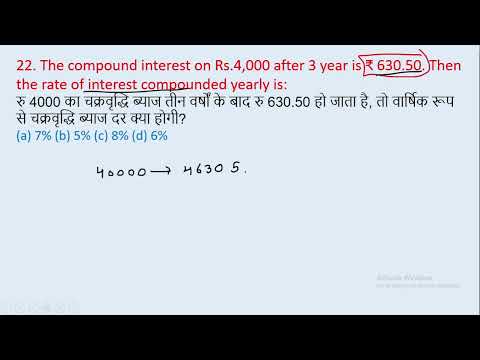
Understanding Compound Interest: Calculating the Rate on ₹4000
This blog post explains how to calculate the rate of interest on an investment of ₹4000 that earned ₹630.50 in interest over three years, demonstrating the process of determining the annual interest rate and its implications.
In this post, we will explore a practical example of calculating the rate of interest on an investment using the concept of compound interest. We will analyze a scenario where an amount of ₹4000 earns ₹630.50 in interest over a period of three years. Our goal is to determine the annual interest rate based on this information.
The Initial Investment and Interest Earned
We start with an initial investment of ₹4000. After three years, the total interest earned on this investment is ₹630.50. To find out how much the total amount has grown, we add the interest earned to the principal:
- Principal Amount: ₹4000
- Interest Earned: ₹630.50
- Total Amount After 3 Years: ₹4000 + ₹630.50 = ₹4630.50
Understanding the Calculation Process
To find the rate of interest, we need to understand how the interest is calculated over the three years. The formula for compound interest can be simplified for our needs. We will first express the total amount in a more manageable form by removing the decimal point:
- Total Amount: 4630.50 can be treated as 4630.5 (for calculation purposes).
Next, we can simplify our calculations by multiplying the total amount by 100 to eliminate the decimal:
- Adjusted Total Amount: 4630.5 * 100 = 463050
Finding the Rate of Interest
To find the rate of interest, we can use the formula for compound interest, which relates the principal, interest, and rate over time. We will rearrange the formula to isolate the rate of interest. The interest earned over three years can be expressed as:
- Interest Formula: Interest = Principal × Rate × Time
Substituting the known values:
- 630.50 = 4000 × Rate × 3
From this equation, we can solve for the rate:
-
Rearranging gives us:
Rate = 630.50 / (4000 × 3)
Rate = 630.50 / 12000
Rate = 0.05254 (approximately) -
To express this as a percentage, we multiply by 100:
Rate = 0.05254 × 100 = 5.254%
Thus, the annual interest rate is approximately 5.25%.
Conclusion
In conclusion, we have determined that the rate of interest on an investment of ₹4000, which earned ₹630.50 over three years, is approximately 5.25%. This example illustrates the process of calculating compound interest and how to derive the interest rate from the total interest earned. Understanding these calculations is essential for making informed financial decisions regarding investments and savings.