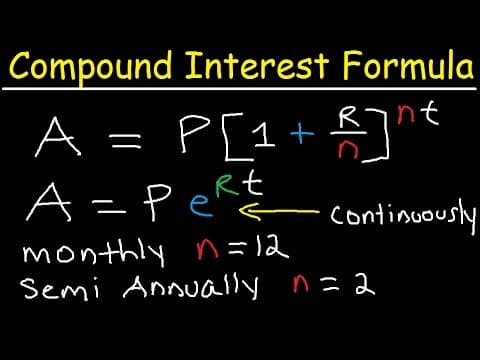
This blog post explains the compound interest formula, its components, and provides practical examples of how to calculate future investment values based on different compounding frequencies. It covers both monthly and continuous compounding scenarios, illustrating the importance of early investment and the impact of interest rates on savings over time.
Compound interest is a powerful concept in finance that allows your investments to grow exponentially over time. In this post, we will explore the compound interest formula, its components, and how to apply it through various practical examples.
There are two primary equations used to calculate compound interest:
General Compound Interest Formula
A = P * (1 + r/n)^(n*T)
Continuous Compounding Formula
A = P * e^(r*T)
Problem: Susan puts $20,000 in a savings account paying 8% annual interest compounded monthly. How much will be in the account after 40 years?
Using the formula:
A = 20000 * (1 + 0.08/12)^(12*40)
Calculating this gives approximately $485,467.79.
This shows the importance of saving early.
Problem: John wants to have $2 million for retirement in 45 years. He invests in a mutual fund paying an average of 9.5% each year compounded quarterly. How much should he deposit?
Using the formula:
A = P * (1 + 0.095/4)^(4*45)
Solving for P gives approximately $29,250.
If John starts investing in his 20s, he can reach his retirement goal by his mid-60s.
Problem: Sarah wishes to turn her $10,000 investment into $100,000 in 20 years. What interest rate does she need, compounded annually?
Using the formula:
100,000 = 10,000 * (1 + r)^20
Dividing both sides by 10,000 gives 10 = (1 + r)^20.
Taking the 20th root and solving for r gives approximately 12.2%.
Sarah needs to find an account that pays this interest rate to achieve her goal.
Problem: Mary invests $50,000 into an index annuity averaging 8.4% per year compounded semiannually. How long will it take for her account to reach $1 million?
Using the formula:
1,000,000 = 50,000 * (1 + 0.084/2)^(2*T)
Solving for T gives approximately 36.4 years.
Problem: Juliet invests $100,000 in an account paying 7.2% interest compounded continuously. How much will be in her account after 30 years?
Using the continuous compounding formula:
A = 100,000 * e^(0.072*30)
Calculating this gives approximately $867,013.77.
Problem: Mark wants to have $1.5 million in 50 years. How much should he invest now in an account paying 12% interest compounded continuously?
Using the formula:
P = 1,500,000 / e^(0.12*50)
This results in approximately $3,718.13.
This small initial investment can grow significantly over time due to the high interest rate and long duration.
Problem: John invests $5 million in an account paying 11% interest compounded continuously. How long will it take for his investment to turn into $2 million?
Using the formula:
400 = e^(0.11*T)
Taking the natural log gives T approximately 54.47 years.
The power of compound interest cannot be overstated. It emphasizes the importance of starting to save early and choosing the right investment vehicles. By understanding and applying the compound interest formulas, individuals can make informed decisions about their financial futures, maximizing their savings and investments over time. Whether you are saving for retirement, a major purchase, or simply growing your wealth, the principles of compound interest will serve you well.