This blog post explores the concept of equivalent rates in simple interest, detailing the formulas for calculating simple interest and simple discount rates, along with practical examples to illustrate their application in financial scenarios.
In the realm of finance, understanding the concept of equivalent rates is crucial for making informed investment decisions. This blog post delves into the topic of equivalent rates under simple interest, explaining how two rates can yield the same maturity value at the end of a term when applied to the same present value.
Equivalent rates refer to the relationship between the simple interest rate (r) and the simple discount rate (d). When both rates are applied to the same present value (P), they yield the same maturity value (F) at the end of a specified term (T). This concept is essential for comparing different financial products and understanding their implications on investments.
To grasp equivalent rates, we need to understand the formulas used for calculating simple interest and simple discount:
Simple Interest Formula:
F = P(1 + rt)
Where:
Simple Discount Formula:
F = P / (1 - dt)
Where:
To find the equivalent rates, we can transform the variables from the above formulas:
The relationship between the simple interest rate and the simple discount rate can be expressed as:
r = d / (1 - dt)
Conversely, we can express the simple discount rate in terms of the simple interest rate:
d = r / (1 + rt)
These equations allow us to convert between simple interest and simple discount rates, facilitating comparisons between different financial scenarios.
Consider a bank that discounts a loan of 160,000 pesos due in three years at a 10% simple discount rate. To find the equivalent simple interest rate:
Using the formula for r:
r = d / (1 - dt)
r = 0.10 / (1 - 0.10 * 3)
r = 0.10 / 0.70
r = 0.143 or 14.3%
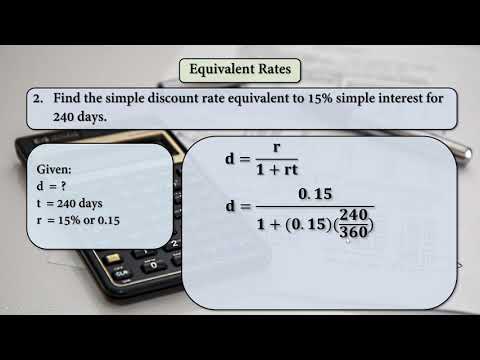
Now, let’s find the simple discount rate equivalent to a 15% simple interest rate for a term of 240 days (using the banker’s rule, which assumes a year has 360 days):
Using the formula for d:
d = r / (1 + rt)
t in years = 240 / 360 = 0.67
d = 0.15 / (1 + 0.15 * 0.67)
d = 0.15 / 1.1
d = 0.136 or 13.6%
How long will it take for 300,000 pesos to grow to 350,000 pesos at a 12% simple interest and simple discount rate?
For Simple Interest:
For Simple Discount:
If 10,000 pesos accumulates to 12,500 pesos in nine months, we can find both the simple interest rate and the simple discount rate:
For Simple Interest:
For Simple Discount:
Understanding equivalent rates in simple interest is vital for anyone involved in financial decision-making. By mastering the formulas and applying them to real-world scenarios, individuals can better navigate their investment options and optimize their financial outcomes. If you have any questions or need further clarification, feel free to leave a comment in the discussion section.