This blog post explores the fundamental concepts of risk and return in finance, detailing how to calculate returns, measure risk, and the importance of diversification. It culminates in the Capital Asset Pricing Model (CAPM), which helps investors determine the required return on an investment based on its risk profile.
In this finance lecture, we delve into the critical concepts of risk and return, focusing on how they interrelate and the implications for investors. We will cover the calculation of returns, methods for measuring risk, the role of diversification in reducing risk, and ultimately, the Capital Asset Pricing Model (CAPM) which provides a framework for pricing risk.
The relationship between risk and return is a cornerstone of finance theory. Generally, investors prefer lower-risk opportunities unless the potential return justifies the additional risk. For instance, if given a choice between a low-risk investment promising a 10% return and a high-risk investment with the same expected return, most would opt for the lower-risk option. This principle underscores the necessity for higher rewards to entice investors to accept higher perceived risks.
Return on investment (ROI) is a measure of the profitability of an investment. For stocks, returns can be derived from two main components:
The formula for calculating the percentage return is:
[ \text{Percentage Return} = \frac{(\text{Ending Price} - \text{Beginning Price}) + \text{Dividends}}{\text{Beginning Price}} ]
This can be broken down into:
Assuming we purchase a stock at $25, receive $2 in dividends, and the stock price rises to $31 after one year, the calculation would be:
[ \text{Capital Gains Yield} = \frac{31 - 25}{25} = 24% ] [ \text{Dividend Yield} = \frac{2}{25} = 8% ] [ \text{Total Return} = 24% + 8% = 32% ]
This example illustrates how to calculate historical returns, which may differ from expected returns, highlighting the concept of risk.
Risk can be defined as the uncertainty regarding the actual returns compared to expected returns. Investors are particularly sensitive to underperformance relative to their expectations. To quantify risk, we often use statistical measures such as volatility, which can be represented by standard deviation or variance of returns.
Volatility indicates how much the returns of an asset deviate from their average. A distribution of returns can help visualize this:
For example, if we compare two stocks with the same average return but different distributions, the stock with the tighter distribution is considered less risky.
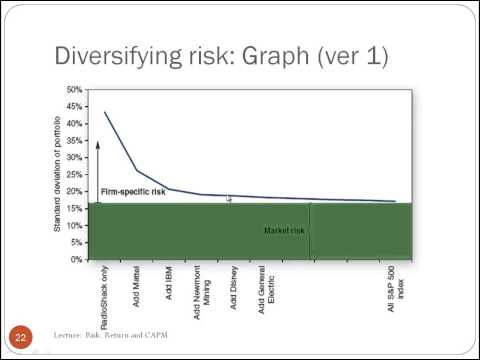
Diversification is a strategy used to reduce risk by investing in a variety of assets. By holding a portfolio of different stocks, the overall volatility can be reduced. For instance, if one pharmaceutical company fails to gain drug approval, it is unlikely that all companies in the sector will fail simultaneously, thus mitigating risk.
The CAPM is a widely used model that helps investors determine the expected return on an asset based on its risk relative to the market. The formula is:
[ \text{Required Return} = \text{Risk-Free Rate} + \beta \times \text{Market Risk Premium} ]
Where:
If the expected market return is 12%, the risk-free rate is 3.5%, and a stock has a beta of 1.08, the required return would be calculated as follows:
[ \text{Required Return} = 3.5% + 1.08 \times (12% - 3.5%) \approx 12.7% ]
This indicates the return an investor would require to compensate for the risk of investing in that stock.
In summary, understanding the dynamics of risk and return is essential for effective investment decision-making. The CAPM provides a structured approach to evaluate the expected returns based on risk, emphasizing that investors should be compensated for the risks they bear. By leveraging concepts such as diversification and the measurement of volatility, investors can better navigate the complexities of financial markets.