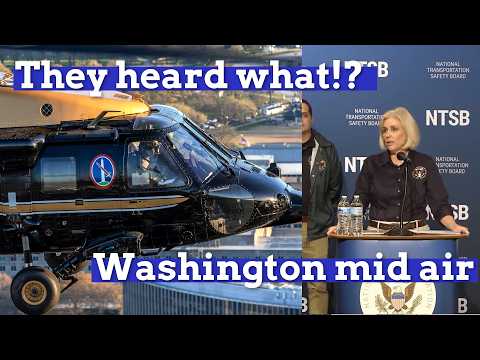
The NTSB's investigation into the Blackhawk helicopter accident reveals critical insights about communication failures, altitude discrepancies, and the challenges of flying with night vision goggles, ultimately highlighting the need for improved safety measures in aviation.
The National Transportation Safety Board (NTSB) has released the findings from the Blackhawk helicopter accident, providing a detailed analysis of the events leading up to the crash. This report uncovers significant issues related to communication, altitude awareness, and the use of night vision goggles, which are crucial for understanding the factors that contributed to this tragic incident.
The NTSB confirmed that the Blackhawk was engaged in a check ride, which combined an annual evaluation with a night vision goggle qualification flight. During such flights, pilots are required to communicate effectively, especially when transitioning between using night vision goggles and regular visibility. However, the cockpit voice recorder revealed that no discussion occurred regarding the removal of the night vision goggles, leading investigators to believe that the pilots were still relying on them during the accident.
Night vision goggles significantly reduce a pilot's peripheral vision from 180 degrees to just 40 degrees. This limitation makes it challenging to detect objects outside of the direct line of sight. As the Blackhawk followed designated helicopter routes, it was expected to maintain an altitude of 200 feet or below. However, the NTSB noted that there were discrepancies in altitude readings that could have contributed to the accident.
An intriguing anomaly was recorded at 8:43:48, approximately four minutes before the crash. The pilot flying reported an altitude of 300 feet, while the instructor indicated 400 feet. This discrepancy suggests that the altimeters may not have been synchronized or set correctly. Pilots typically rely on barometric altitude, which can be affected by changes in air pressure. If the altimeters were incorrectly adjusted, the pilots could have had a false sense of their actual altitude.
The NTSB also noted that there was no discussion regarding these altitude discrepancies, which raises concerns about situational awareness in the cockpit. Although the Blackhawk's radio altimeter provided accurate data, the lack of GPS information in the flight data recorder limited the NTSB's ability to cross-reference altitude data.
Two minutes before the accident, Air Traffic Control (ATC) informed the Blackhawk of a CRJ aircraft circling to Runway 33. However, the Blackhawk's cockpit voice recorder did not capture the term "circling," indicating a lack of awareness of the CRJ's location. This communication gap became even more critical just seven seconds before the crash when ATC instructed the Blackhawk to pass behind the CRJ. The pilots keyed their microphone before the transmission was complete, missing crucial information about the CRJ's position.
The NTSB highlighted that both the Blackhawk and the CRJ used VHF transmissions for communication, which, while effective over long distances, can suffer from clarity issues. Unlike modern digital radios, which allow multiple transmissions simultaneously, VHF radios in aviation prioritize single transmissions, potentially leading to misunderstandings.
In the moments leading up to the accident, the Blackhawk's radio altimeter indicated an altitude of 278 feet. The helicopter was flying nearly level, with only a slight nose-up pitch and a left roll. The NTSB found no electronic warnings in the Blackhawk regarding the approaching CRJ, and it was noted that the Blackhawk was not transmitting ADS-B information, which could have provided additional situational awareness.
Conversely, the CRJ was aware of the Blackhawk's presence but was not given traffic avoidance instructions due to its altitude being below 500 feet. This limitation is designed to prevent aircraft from descending into the ground, but it also means that critical avoidance information may not be communicated in time.
The NTSB's investigation into the Blackhawk helicopter accident reveals a complex interplay of communication failures, altitude discrepancies, and the challenges posed by night vision goggles. As the NTSB continues its work, including simulations to better understand the pilots' perspectives, it is clear that this incident underscores the need for improved safety measures and communication protocols in aviation. The findings serve as a reminder of the importance of situational awareness and the critical role that clear communication plays in preventing accidents in the skies.