
World War I was precipitated by a complex interplay of nationalism, militarism, alliances, and imperialism, leading to a global conflict characterized by unprecedented military technology and total war strategies that transformed societies and political landscapes.
World War I, a pivotal event in global history, was not merely a result of a single incident but rather a culmination of various factors that escalated tensions among nations. This blog post delves into the causes of World War I and the methods employed during the conflict, providing a comprehensive overview of how these elements intertwined to shape the war.
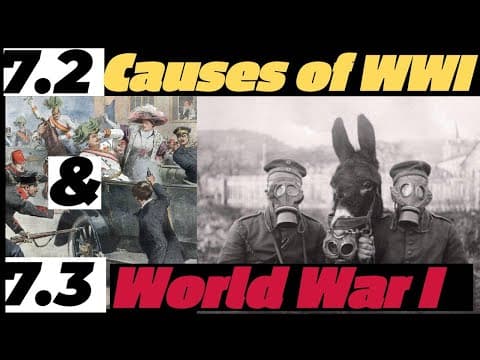
On June 28, 1914, Archduke Franz Ferdinand of Austria-Hungary was assassinated by a Serbian nationalist. This event set off a chain reaction of declarations of war that would engulf much of the world. Within a month, Austria-Hungary declared war on Serbia, prompting Russia to mobilize its troops in defense of Serbia. Germany quickly declared war on Russia and subsequently on France, leading to the invasion of Belgium, which brought Britain into the conflict.
Nationalism played a crucial role in the lead-up to the war. Ethnic nationalism in the Balkan Peninsula intensified rivalries, particularly between Serbia and Austria-Hungary. Following the Balkan Wars, Serbia emerged as a significant regional power, threatening Austria-Hungary's stability. The annexation of Bosnia by Austria-Hungary in 1908 further inflamed tensions, as Serbia sought to unite all Slavic peoples under its banner, supported by Russia.
By 1914, Europe was divided into competing nation-states, where war was seen as a demonstration of national strength and vitality. Nationalism not only united people but also distracted them from internal class divisions, fostering a sense of unity among the populace.
Militarism, while not explicitly listed as a cause by the College Board, can be viewed as a subcategory of nationalism. As nationalistic fervor grew, so did the desire to showcase military strength. European nations significantly increased their military budgets, leading to the establishment of large standing armies and advanced military technologies. The development of elaborate war plans, such as Germany's Schlieffen Plan, further incentivized aggressive postures among nations, leaving little room for diplomatic resolutions.
The complex web of alliances among the great powers was a direct catalyst for the escalation of regional conflicts into a world war. The Triple Alliance (Germany, Austria-Hungary, and Italy) and the Triple Entente (Britain, France, and Russia) created a situation where a conflict involving one nation could quickly draw in its allies. When Austria-Hungary declared war on Serbia, Russia mobilized to support Serbia, leading Germany to declare war on Russia and subsequently on France. The British entered the war following Germany's invasion of Belgium, a neutral country.
Imperial ambitions also contributed to the war's escalation beyond Europe. European nations had extensive overseas empires, and the outbreak of war saw British and French forces invading German colonies in Africa and Asia. Japan, allied with Britain, seized German possessions in the Pacific, while the Ottoman Empire joined the conflict on the side of Germany and Austria-Hungary, motivated by its own territorial losses to imperial powers.
The nature of warfare during World War I was transformed by industrialization, which allowed for the mass production of weapons. The conflict saw the use of approximately 1 billion artillery shells and billions of bullets, alongside extensive barbed wire defenses. The combination of trenches, artillery, and machine guns created deadly zones known as No Man's Land, where countless soldiers perished before reaching enemy lines.
Innovations such as poison gas, flamethrowers, submarines, and military aircraft introduced new horrors to the battlefield. The first tanks made their appearance during the war, marking a significant shift in military tactics. The scale of industrial warfare resulted in over 10 million military deaths and countless injuries.
World War I is often characterized as the first Total War, where the objectives, methods, and mobilization efforts extended beyond traditional military aims.
Unlike previous conflicts, the goal of World War I became the complete destruction of the enemy. The Treaty of Versailles, which ended the war, imposed harsh penalties on Germany, including territorial losses and crippling reparations, aimed at ensuring it would never again pose a threat.
Nations employed every available method to sustain the war effort, including the use of illegal poison gas and targeting civilians. Propaganda played a significant role in shaping public perception, dehumanizing the enemy while glorifying one's own soldiers.
Total War required the mobilization of entire populations and economies. Governments enforced rationing and repurposed factories for military production, often employing women in roles traditionally held by men who were sent to the front lines. Colonies also contributed significantly to the war effort, with soldiers from British India, Africa, and Vietnam participating in the conflict.
To maintain control over the war effort, governments intensified censorship and suppressed dissent, curtailing freedoms in the name of national security. This shift marked a departure from Enlightenment ideals of freedom and democracy.
The war brought about transformative social and cultural changes. Women's contributions to the war effort led to increased empowerment and, in many countries, the eventual granting of voting rights. The war also shattered the myth of progress and diminished European prestige among colonized peoples.
The causes and conduct of World War I illustrate the complex interplay of nationalism, militarism, alliances, and imperialism that led to one of the deadliest conflicts in history. The war not only reshaped the geopolitical landscape but also had profound social and cultural impacts that would resonate for generations to come. Understanding these dynamics is crucial for grasping the long-term effects of the war, which will be explored in future discussions.



















