Los Angeles International Airport (LAX) faces significant traffic challenges due to its design and capacity limitations. Despite a $30 billion modernization plan, experts argue that without a comprehensive public transit solution, traffic congestion will persist. The introduction of a people mover and rideshare solutions like LAXIT aim to alleviate some issues, but a long-term strategy is needed to match airside capacity with landside demand.
Los Angeles International Airport (LAX) is one of the busiest airports in the world, uniquely positioned as an origin and destination airport, unlike many others that primarily serve as hubs. This distinction leads to significant traffic congestion, as most passengers either start or end their journeys at LAX. With a staggering 95,000 vehicles entering the airport daily, the mismatch between passenger volume and vehicle capacity creates a complex challenge for airport management.
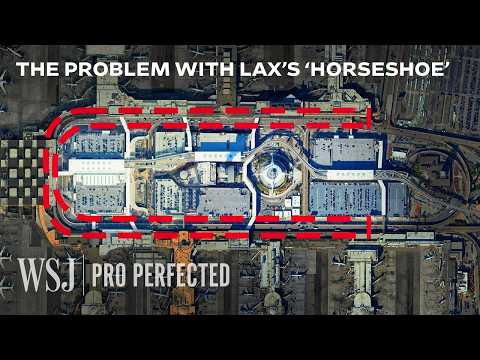
The core issue at LAX is its horseshoe-shaped design, which complicates traffic flow. The airport's layout results in a landside capacity problem, where the lack of effective public transit options and insufficient roadway space exacerbate congestion. The horseshoe configuration forces vehicles to navigate a tight space, leading to constant side-to-side movement as drivers attempt to drop off passengers or find parking. This design flaw limits the airport's ability to expand effectively.
LAX has three main access points for vehicles, all of which converge quickly, leading to bottlenecks. The traffic movement within the horseshoe is not linear; instead, it involves a lot of lateral movement, which slows down the overall flow. Attempts to create shortcuts for travelers heading to distant terminals have inadvertently worsened the situation by funneling more traffic into already congested areas.
In response to these challenges, LAX is embarking on a $30 billion modernization initiative aimed at improving the airport's infrastructure. A key component of this plan is the introduction of a people mover, a $3 billion project set to open in 2026. This system will transport passengers from a designated drop-off point to the terminals, reducing the number of vehicles entering the congested horseshoe area.
The people mover will run down the center of the airport, with pedestrian walkways connecting to the terminals. This design aims to encourage passengers to drop off their vehicles at the station rather than driving into the horseshoe. To further incentivize this shift, experts suggest implementing congestion pricing on the roadways, which would reduce traffic demand and improve the experience for those who still need to drive into the airport.
While the people mover is under construction, LAX has introduced a temporary solution known as LAXIT, a rideshare and taxi lot located near the airport entrance. This initiative aims to divert rideshare traffic away from the horseshoe, reducing congestion by approximately 15% compared to 2019 levels. However, LAXIT is not intended to be a permanent fixture; it may eventually be replaced by a new concourse.
Although LAXIT has improved traffic flow, it presents its own challenges. Travelers must navigate poorly marked pathways and construction zones to reach the rideshare area, particularly those coming from the furthest terminals. Shuttle buses with dedicated lanes help mitigate some of these issues, but the overall experience remains cumbersome for many passengers.
As LAX looks to increase its airside capacity, the airport must also address its landside limitations. The introduction of new concourses and terminals could lead to increased passenger traffic, especially with the upcoming 2028 Olympics. However, simply expanding the airport's capacity may not be sufficient to alleviate congestion.
Comparatively, airports like Atlanta International have more flexible layouts that allow for expansion without significantly impacting landside capacity. LAX's horseshoe design restricts its ability to adapt and grow, making it crucial for airport planners to consider innovative solutions that enhance both airside and landside operations.
The modernization of LAX is a monumental task that requires careful planning and execution. While the $30 billion investment aims to address current challenges, experts emphasize the need for a comprehensive public transit strategy to truly alleviate traffic congestion. By aligning landside capacity with the airport's airside capabilities, LAX can enhance the travel experience for millions of passengers while maintaining its status as a vital hub in global air travel.